culture
Art Basel 2025 Opens with Record-Breaking Sales
Premier art fair reports multiple million-dollar transactions on opening day, with Hockney painting fetching up to $17 million, signaling strong Swiss art market.
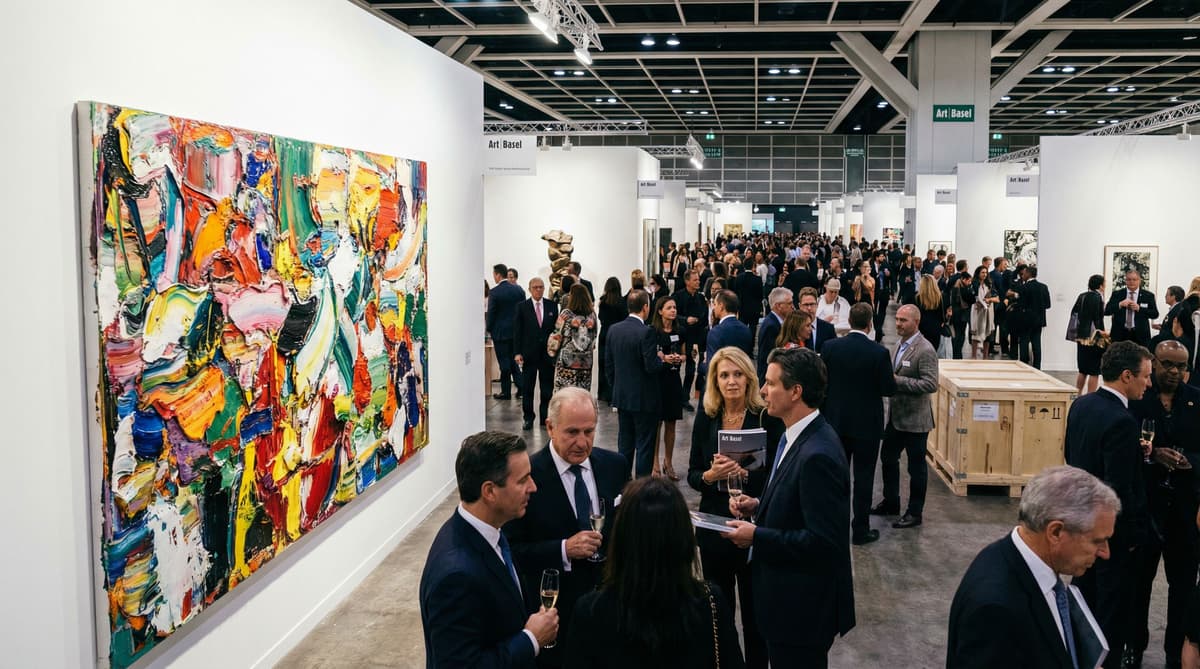
Art Basel 2025 has exploded out of the gate, silencing economic skeptics with a staggering display of wealth and confidence. On the very first preview day, the cash registers were ringing at a deafening volume, led by a massive sale that sets the tone for the entire week. A 2006 masterpiece by British icon David Hockney, Mid November Tunnel, commanded a price between $13 million and $17 million (CHF 10.6-14 million), instantly becoming the fair's crown jewel.
Offered by London's Annely Juda Fine Art, the work was snapped up by a private collector, signaling that the appetite for blue-chip investment art remains voracious. This isn't just a transaction; it is a statement. While other global markets grapple with volatility, the upper echelon of the art world, anchored here in Basel, is operating in a reality of its own. The sheer speed of this eight-figure deal underscores a critical fact: when the doors open at Messeplatz, the world's elite are ready to spend, and they are spending big.
Zurich's Hauser & Wirth Dominates Home Turf
Playing on home soil, the Zurich-based powerhouse Hauser & Wirth has delivered a masterclass in market dominance. The gallery didn't just participate; it conquered the floor, announcing a stunning seven separate sales exceeding the million-dollar mark on day one alone. This performance cements their status as one of the undisputed heavyweights of the Swiss and international art scene.
The gallery's sales ledger reads like a curator's wish list. Two paintings by Mark Bradford flew off the walls for $3.5 million each, while George Condo's psychological portraits generated $4.9 million in total, with two works selling for $2.45 million apiece. Even sculpture saw heavy movement, with a Louise Bourgeois piece fetching a cool $1 million. Hauser & Wirth's aggressive success demonstrates that despite the global competition, Swiss galleries retain a formidable edge in connecting top-tier inventory with serious capital.
International Titans Flex Financial Muscle
Across the aisle, the New York giants are throwing their weight around with equal ferocity. The David Zwirner Gallery, a perennial titan of the industry, orchestrated the sale of a sculpture by Ruth Asawa for a breathtaking $9.5 million. Asawa, who passed away in 2013, has seen her market value soar, and this sale represents a critical benchmark for her estate.
But Zwirner wasn't finished. The gallery also closed a deal on a work by German visual artist Gerhard Richter for $6.8 million. These transactions highlight a bifurcation in the market: while mid-tier works may linger, the demand for proven, historical masterpieces is insatiable. The willingness of collectors to drop nearly $10 million on a single sculpture on the opening afternoon proves that liquidity at the top of the pyramid is not just present—it is overflowing.
The Baselitz Blitz: A Market Obsession
If there is one name on everyone's lips this year, it is Georg Baselitz. The German neo-expressionist is currently enjoying a surge in demand that borders on obsession. Collectors are scrambling to acquire his works, sparking a frenzy across multiple gallery booths. Salzburg's Thaddaeus Ropac gallery capitalized on this heat, selling two Baselitz pieces for $1.8 million and $1.2 million respectively.
Meanwhile, London's White Cube joined the fray, securing €2.2 million for yet another Baselitz painting. This widespread buying pattern indicates a coordinated confidence in the artist's long-term value. When multiple major galleries move significant inventory of the same artist simultaneously, it signals a robust, healthy market consensus. Baselitz is not just surviving the test of time; in 2025, he is thriving.
Switzerland Remains the Global Art Epicenter
As the dust settles on a frantic opening day, one truth is undeniable: Switzerland remains the beating heart of the global art economy. The sheer volume of million-dollar transactions—from Hockney's $17 million peak to the flurry of sales at Hauser & Wirth—demonstrates a resilience that other sectors can only envy. Art Basel is more than a trade fair; it is a barometer for the health of the ultra-luxury market.
For the Swiss economy, this influx of international capital and prestige is invaluable. The fair reinforces Basel's reputation not just as a cultural destination, but as a serious financial hub where the world's wealthiest individuals feel comfortable transacting. With days left in the fair, the momentum shows no signs of slowing. If day one is any indication, 2025 will go down in history as a vintage year for the Swiss art market.