University of Bern
University of Bern receives major diamond collection for research
The University of Bern is to house one of the world’s largest research diamond collections after receiving more than 29,000 rough diamonds donated for scientific and teaching purposes. Researchers will use the diamonds as natural archives to study minerals and the Earth’s interior.
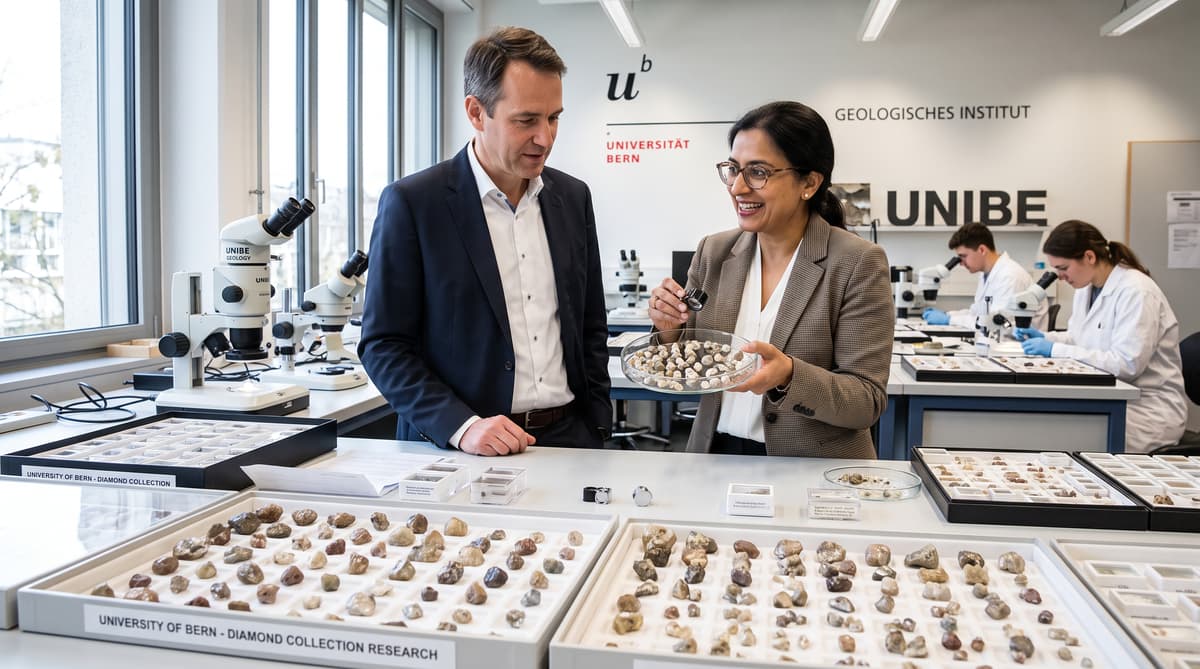
More than 29,000 rough diamonds are heading into the scientific orbit of the University of Bern, giving Switzerland one of the world’s most extensive resources for diamond research and teaching. The Harris Diamond Collection was donated by Jeffrey W. Harris and his wife, Francesca Harris, and will be housed off campus.
The collection carries little commercial value. Each stone is worth about $10, or CHF 8.20, on average. Its importance lies in what the diamonds preserve: evidence of the pressure, temperature and chemical conditions present deep inside the Earth when they formed.
The University of Bern announced the donation on September 22, 2026. Researchers will use the material to investigate minerals and study the formation and evolution of the planet’s interior. Students will also gain access to a broad teaching collection rather than relying on a small number of unusually large or valuable specimens.
The stones were originally donated by the Diamond Trading Company in London to Harris for scientific research. Each contribution is documented by an original deed of gift, creating a record of the collection’s provenance.
Read the Earth’s Deep History
Diamonds as old as 3.5 billion years can preserve information from periods long before modern continents took shape. Their crystal structure is exceptionally durable and chemically stable, allowing traces of their formation environment to survive over geological time.
Some stones contain tiny inclusions of high-density liquid, molten material or minerals. These inclusions act as sealed samples from depths that scientists cannot reach directly. By examining them, researchers can reconstruct the pressures and temperatures that shaped the Earth’s mantle and investigate how the planet evolved.
The collection includes diamonds formed at very different points in geological history. The oldest date back about 3.5 billion years, while the youngest are roughly 55 million years old. That range gives scientists material for comparing changing geological conditions across immense stretches of time.
Researchers can cut, crush and analyse selected stones, while preserving others for future work. The University of Bern describes the diamonds as natural archives because each specimen can carry a distinct chemical record. The collection’s breadth increases the chance of finding rare inclusions and unusual mineral associations.
Map the Stones Across Five Regions
Five continents and regions are represented in the collection: Africa, South America, North America, Asia and Oceania. The geographic spread gives researchers specimens formed in different geological settings and provides teaching material for comparing the origins of diamonds around the world.
The stones came to Harris through donations from the Diamond Trading Company in London, which supplied them for scientific research. The original deeds of gift document each donation. That paper trail matters for a research collection, since the geological interpretation of a specimen depends partly on knowing where it came from and how it entered the archive.
The University of Bern will house the collection off campus. There, researchers can select samples for mineralogical study and students can examine rough stones in a controlled academic environment. The material will support work on diamond formation, mineral inclusions and the processes operating in the Earth’s interior.
The donation also strengthens Switzerland’s position in a highly specialised area of Earth science. Bern’s researchers will have access to a large comparative sample, rather than a handful of isolated stones, allowing them to identify patterns across regions and ages.
Put Bern’s Specialist Tools to Work
Specialised equipment at the University of Bern will allow scientists to process and analyse the diamonds in detail. The university is one of the few institutions worldwide with its own diamond grinding wheel and diamond crushing facility. It also operates a high precision mass spectrometer for isotope analysis and methods that visualise the chemical composition of materials in space.
Those tools enable researchers to work from the scale of a visible crystal to the chemistry of microscopic inclusions. Grinding and crushing expose material for laboratory analysis. Isotope measurements can help establish geological histories, while chemical imaging reveals how elements are distributed through a specimen.
The Harris Diamond Collection will therefore function as both an archive and a working research resource. Some stones may provide material for new studies of minerals that form under extreme pressure. Others will support teaching in mineralogy, geochemistry and Earth sciences.
For Switzerland, the donation connects a private act of philanthropy with existing public research capacity. The stones are modestly valued as commodities, yet their scientific use depends on equipment, documentation and expertise already concentrated at Bern. That combination gives the collection its long-term value.