Transport
Switzerland’s first public robotaxi service begins in Zurich canton
Switzerland’s first publicly accessible robotaxi pilot is now operating in Zurich’s Furttal valley. Three electric autonomous vehicles serve around 100 designated stops, offering an early test of how self-driving transport could work in smaller Swiss municipalities.
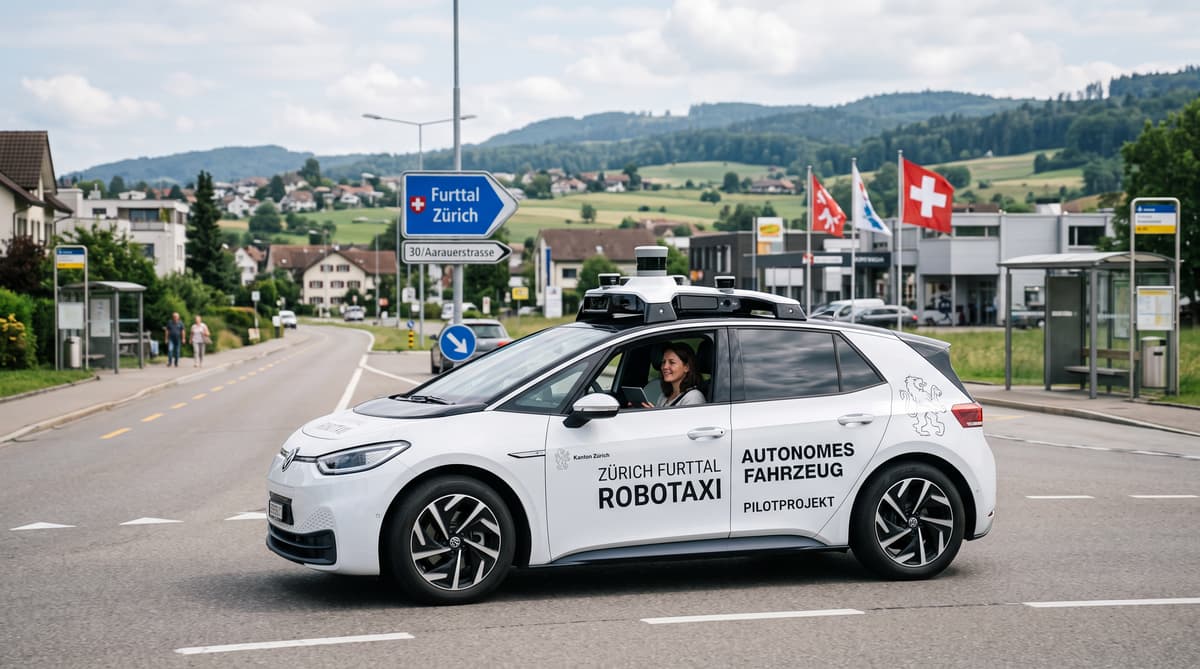
Three electric robotaxis are now carrying passengers through Zurich’s Furttal valley. The Iamo pilot gives Switzerland its first publicly accessible self driving taxi service, opening a practical test of automated mobility in four smaller municipalities: Boppelsen, Dänikon, Hüttikon and Otelfingen.
Passengers book through the Iamo app, whose name stands for “intelligent automated mobility”. The service connects around 100 designated stops, allowing residents to request a ride rather than wait for a fixed route. Each vehicle carries up to three passengers and currently operates every day from 1pm to 5pm.
The launch matters because Furttal reflects a common Swiss transport challenge. Communities outside major urban centres often have rail access, but limited local connections for the first or last part of a journey. The pilot places robotaxis alongside a suburban railway line, giving Swiss Transit Lab, Zurich and Aargau authorities, and Swiss Federal Railways a live setting in which to examine how automated cars could feed passengers into conventional public transport.
Zurich’s Office for Mobility is taking a measured approach. Pascal Kern, its head, says the authorities want to introduce the technology gradually. The first passengers will therefore experience a controlled service, operating within a defined area and schedule.
Book, Board and Connect to Rail
Around 100 stops give the pilot a village scale and a transport network to test. Users must download Iamo from the Apple App Store or Google Play, register, select a journey and walk to a designated collection point. The app handles bookings while the vehicle follows its approved operating area.
The four municipalities offer different reasons to study automated transport outside a major city. Boppelsen, Dänikon, Hüttikon and Otelfingen are close enough to Zurich’s wider transport system to provide links with rail, yet dispersed enough to expose the gaps between stations, homes and local destinations. Those links could matter for older residents, people without cars and commuters travelling beyond the railway timetable.
The service remains deliberately limited. A three passenger capacity restricts the number of people each trip can carry, and the four hour daily window gives operators a narrow period for collecting data. Users also need to plan around fixed stops rather than request a vehicle from any address.
Iamo is a pilot, so Switzerland’s GA and Half Fare travelcards cannot be used. The service is also outside the regular public transport fare system. That separation allows operators to assess demand and operating costs before any decision about wider integration.
Low Fares Put Robotaxi Demand to the Test
A 10 kilometre Iamo journey costs about CHF 8.50, compared with roughly CHF 44 in a conventional Zurich taxi. The pilot’s fare begins at CHF 4.70, followed by CHF 0.38 per kilometre, putting the service within reach of passengers who might find a standard taxi too expensive for routine local travel.
The pricing gives operators a way to test whether lower fares can generate demand in municipalities with fewer passengers per square kilometre. It also highlights a practical limit of the experiment. Iamo does not accept the Swiss GA or Half Fare travelcards, and passengers cannot use the ordinary public transport fare system. A customer may therefore pay separately for a robotaxi connection and a train journey.
That issue will become more important if automated services move beyond the pilot. A useful feeder service must fit into the way people already buy tickets, plan connections and transfer between modes. Swiss Federal Railways is part of the project, giving the organisers a direct partner for examining those connections.
For now, the financial proposition is clear at the individual trip level. The challenge is to establish whether the fare can support reliable service, vehicle maintenance, supervision and expansion once the pilot environment becomes more demanding.
Safety Rules Shape the First Public Trial
The vehicles still carry a safety driver, and the front passenger seat remains empty. Iamo operates in ordinary traffic, but passengers are not yet travelling in a fully driverless taxi. The safety arrangement gives the project team a person who can monitor conditions and respond if the automated system requires help.
The pilot follows preparatory work that began in summer 2025, when organisers produced a detailed map of the operating area. Astra, the Federal Roads Office, authorised automated driving for the trial in November 2025. Subsequent testing was described as largely uneventful, clearing the way for public bookings.
The next technical step would involve automated minibuses operating without a safety driver inside. Trained staff would supervise those vehicles remotely, though that model requires additional approval from Astra. The change would affect staffing, emergency response, insurance and the design of the service itself.
Switzerland’s cautious timetable stands apart from developments in China and the United States. Apollo Go and Waymo already carry paying passengers in fully driverless services, with larger fleets and extensive operational experience. Their progress reflects testing at scale. Iamo begins with three vehicles, a limited geography and a safety driver, giving Swiss regulators and operators a smaller but closely observed basis for future decisions.
The Pilot Sets Switzerland’s Next Route
The pilot’s next milestone is a remotely supervised minibus that can operate without a safety driver. Reaching that stage will depend on further Astra approval and on evidence gathered from the current passenger service. Operators must show that the vehicles can handle local roads, mixed traffic, changing weather and the needs of people who depend on predictable connections.
Furttal offers a useful test because its transport demand is spread across several municipalities rather than concentrated in a city centre. That setting can reveal whether automated vehicles fill genuine gaps or simply replace journeys that residents would already make by car, bicycle or on foot. It can also show how much service people expect during the morning and evening peaks, outside Iamo’s current 1pm to 5pm schedule.
The project’s partners will have to weigh convenience against cost and public acceptance. Remote supervision could reduce the staffing burden, but it would require reliable communications, clear intervention procedures and trained personnel capable of overseeing several vehicles. Ticket integration with rail and regional public transport would also influence whether passengers view robotaxis as part of the network.
Switzerland’s first public robotaxi service therefore begins as a modest local operation. Its results could shape how cantons approach automated transport in villages, suburbs and transport corridors across the country.