Geneva
Geneva’s religious-symbols ban heads for a legal battle
Geneva’s ban on conspicuous religious symbols for members of cantonal and municipal parliaments is facing a legal challenge. The article would explain the constitutional amendment, the arguments about religious freedom and how the courts may test the limits of secularism in Swiss public life.
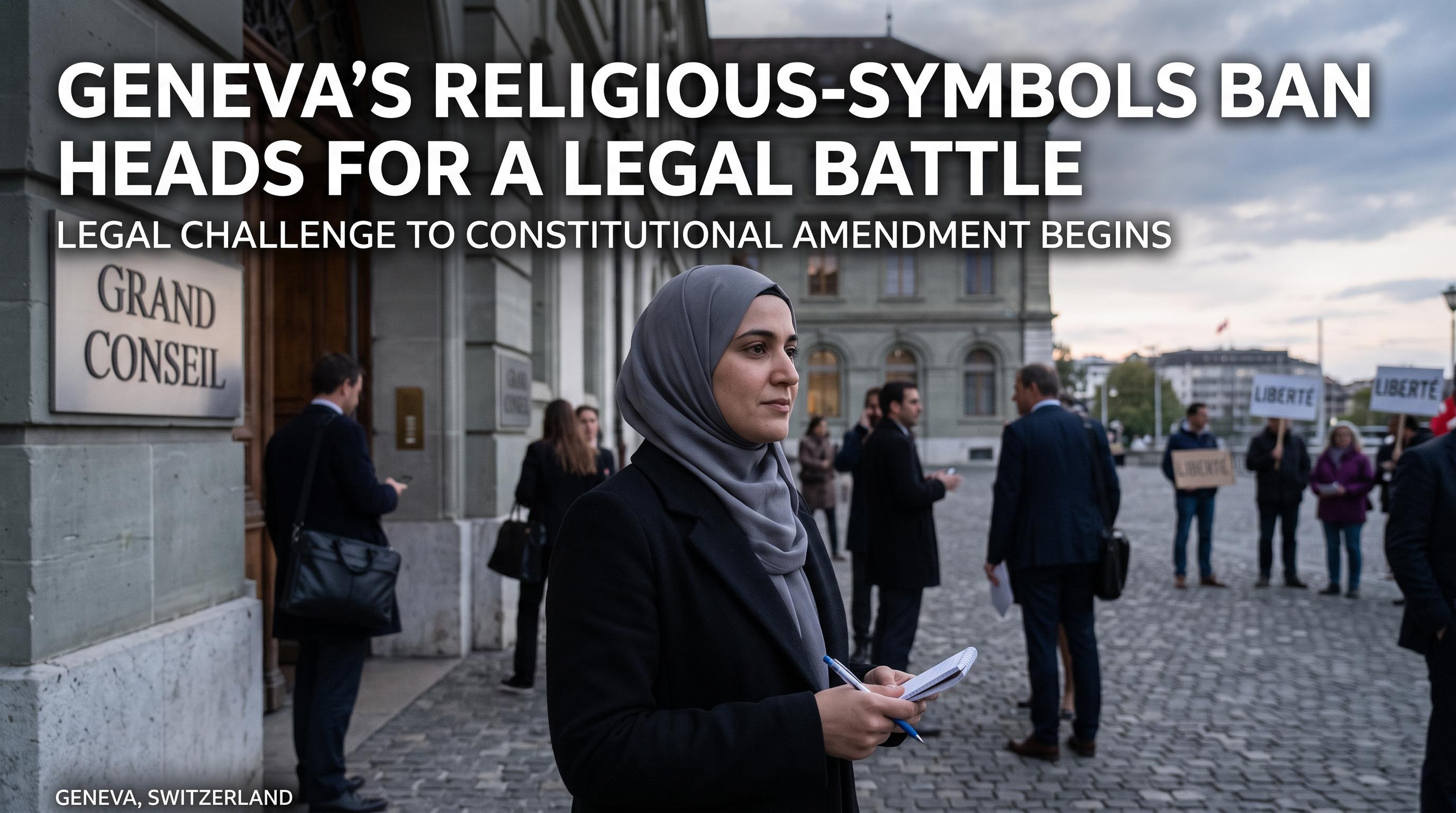
Geneva’s ban heads to court
Four legal challenges now put Geneva’s religious-symbols ban before the courts. Voters approved the constitutional amendment by 51.5% in June 2026, but the narrow result did not close the dispute. The amendment prevents members of cantonal and municipal parliaments from wearing conspicuous religious symbols, including headscarves, kippahs and crosses.
The measure has triggered objections from Green parliamentarians, evangelical Christians, a Protestant local politician and two private citizens, one Muslim and one Christian. Their complaints broadly invoke freedom of conscience, democratic participation, higher law and individual fundamental rights.
The timing gives the case immediate weight. Geneva’s parliament adopted the proposal after years of disagreement over whether elected legislators should face the same neutrality rules as executive officials. The amendment now moves that disagreement into the legal system, where judges will assess how far the canton can extend its model of laïcité.
The court proceedings will also clarify whether Geneva may regulate the visible religious expression of elected representatives who sit in bodies intended to reflect the population. No ruling has yet settled the challenges.
A narrow vote deepens the divide
The amendment passed by a margin of just 1.5 percentage points. Geneva’s electorate backed the proposal in June, while the cantonal government opposed it. The result gave supporters a constitutional mandate, yet its narrow margin exposed the depth of the political divide.
The campaign grew from a coalition that included the Swiss People’s Party, the Liberals, the Centre and the right-wing populist Mouvement Citoyen Genevois. They argued that conspicuous religious symbols could affect the chamber’s appearance of confessional neutrality and distract from parliamentary debate.
Opposition came mainly from the left. Carole-Anne Kast, a Socialist member of Geneva’s cantonal government, called the measure unconstitutional after the vote. Critics say the ban reaches beyond the state’s duty to remain neutral and places a burden on individuals exercising an elected mandate.
Because the proposal changed Geneva’s constitution, voters had the final say. That procedural route has made the dispute more consequential. The courts cannot simply revisit the political campaign. They will examine whether a popular constitutional amendment complies with superior legal protections, including freedom of religion and conscience.
Geneva expands its model of laïcité
Geneva’s neutrality rules already reach deep into public life. The canton has enforced a strict separation of church and state since 1907, making it an outlier within Switzerland. Since 2019, members of the cantonal government and municipal executives have been required to refrain from displaying religious symbols while performing official duties. Civil servants and teachers face similar restrictions.
Parliamentarians were originally excluded. Geneva’s Constitutional Chamber drew a distinction between officials who embody the state and elected legislators who represent the electorate in its diversity. That reasoning became the target of supporters of a broader ban.
Céline Zuber-Roy, a Liberal parliamentarian, highlighted the issue last year by appearing in the chamber wearing a colander. The object is associated with Pastafarianism, a satirical religion created by American physics graduate Bobby Henderson in 2005. Zuber-Roy used the stunt to argue that conspicuous religious symbols could alter the chamber’s public image and divert attention from debate.
The parliament later voted to place the prohibition in the constitution. The legal challenges now test whether the distinction between representing the state and representing society can survive Geneva’s expanded definition of secular neutrality.
Challengers invoke fundamental rights
The challengers place freedom of conscience at the centre of the case. Their arguments say Geneva cannot use secularism to remove individuals from full participation in elected institutions because they display a religious affiliation. The complaints also raise democratic concerns, since parliamentary seats are filled through elections and legislators speak for voters with varied beliefs.
The legal conflict draws a sharp line through Geneva’s interpretation of neutrality. Supporters of the ban see the parliament as a public institution whose members should project a common, non-confessional image. Opponents view elected lawmakers as citizens exercising political rights, not civil servants delivering state authority.
That distinction has practical consequences. A restriction applied to a government minister or teacher may be justified differently from one imposed on a parliamentarian who debates legislation, votes on budgets and represents constituents. The courts will need to consider whether those roles carry different obligations under fundamental-rights protections.
The challenges also include a Muslim and a Christian applicant, alongside Green parliamentarians and Protestant opponents. Their range of backgrounds underscores that the dispute is not confined to one faith community. It concerns the conditions under which religious identity can appear in Swiss public institutions.
A test for Swiss secularism
The case could define how far Swiss cantons may push religious neutrality. Geneva’s policy resembles France’s more restrictive tradition of laïcité, while other Swiss cantons generally take a less expansive approach to visible religious expression in public institutions. A ruling on Geneva’s amendment would therefore attract attention beyond the canton’s borders.
The courts will examine the compatibility of the constitutional change with higher law and fundamental rights. The legal challenges do not erase the popular vote, and the vote does not remove the judiciary’s duty to review cantonal rules. That relationship is a familiar feature of Swiss federalism, where direct democracy operates alongside constitutional and rights-based controls.
For Geneva’s political institutions, the immediate issue is whether parliamentarians can continue to participate while wearing conspicuous symbols. For Switzerland, the broader question concerns the boundary between institutional neutrality and personal freedom in elected office.
The proceedings will also show whether Geneva’s 2019 restrictions provide a legal foundation for extending the ban to legislatures, or whether the Constitutional Chamber’s earlier distinction remains decisive. Until the courts rule, the amendment remains a contested change to Geneva’s constitutional order.