agriculture
Swiss cooperative provides CHF7.2 million in drought relief to farms
Fenaco will distribute CHF7.2 million in one-off drought relief to around 13,000 Swiss agricultural businesses after this summer’s heatwave and water stress. Report on how the payments will work, the pressure facing farms and whether cooperative support can address broader climate-related agricultural losses.
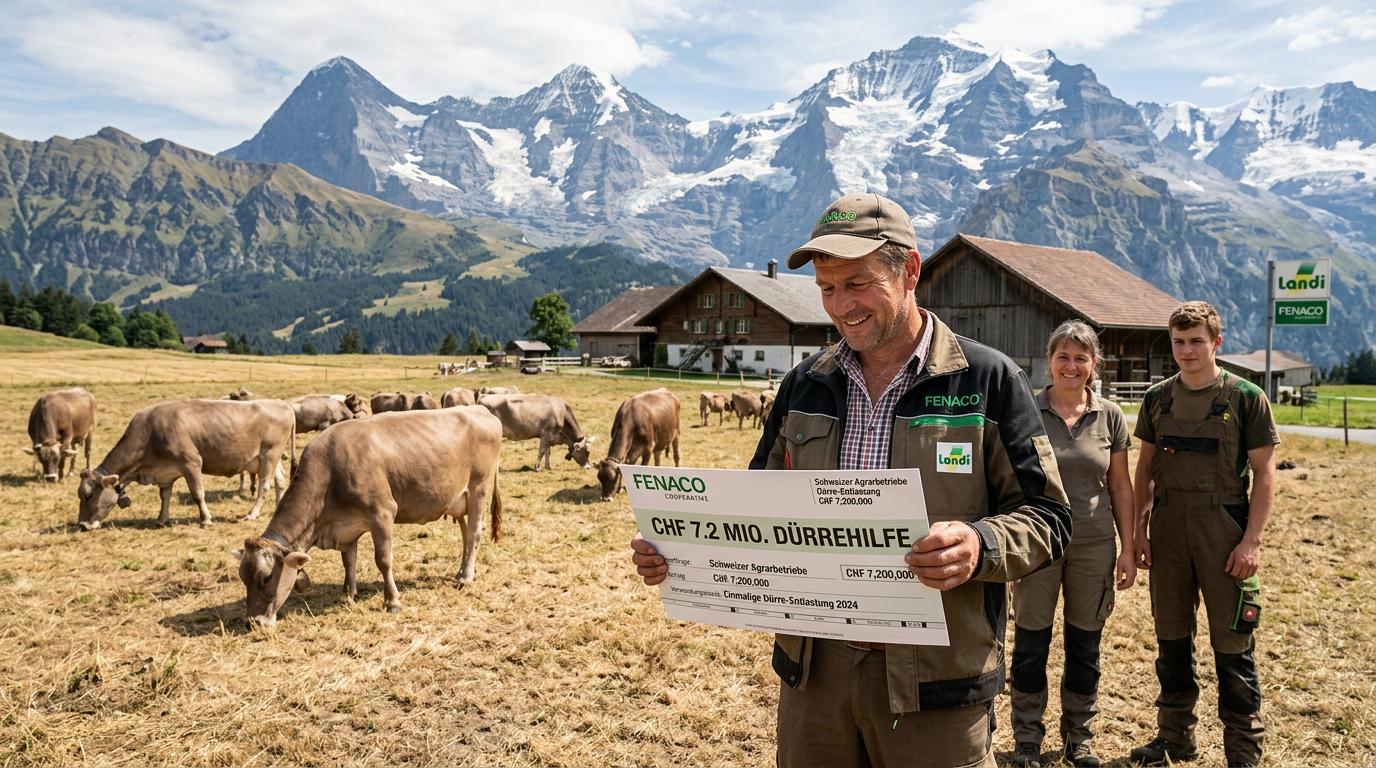
Fenaco moves CHF 7.2 million to farms
CHF 7.2 million will reach around 13,000 Swiss agricultural businesses after a summer marked by heat and water stress. Fenaco, the country’s large agricultural cooperative, announced the one-off payment on September 18, saying farms had been placed under severe strain by the heatwave.
The money will be distributed through Fenaco’s profit-sharing scheme. Eligible members will receive between CHF 100 and CHF 2,000, with the amount credited through Landi shops over the coming months. The payment therefore uses an existing cooperative relationship rather than a new public application system.
For farms managing livestock, crops and seasonal cash flow, the timing matters. Drought can raise the cost of feed and water, reduce yields and increase the need for purchased inputs. The source does not provide a total estimate for losses across Swiss agriculture, or set out a compensation formula tied to individual damage. It does establish the scale of the cooperative response: thousands of farms will receive direct assistance as they enter the next stage of the production cycle.
Fenaco’s announcement places private cooperative support at the centre of the immediate response to this year’s weather pressure. The payments will provide some liquidity, while leaving each farm to absorb the difference between the contribution and its actual losses.
Landi shops become the payment channel
Payments will range from CHF 100 to CHF 2,000 per cooperative member. Fenaco says the money will be credited via Landi shops over the coming months, as part of its profit-sharing system.
That arrangement reflects how Swiss agricultural cooperatives connect farms to the wider market. Landi outlets are familiar points of contact for producers buying feed, seed, equipment and other supplies. Crediting the relief through that network can give members practical access to the support without requiring a separate distribution channel.
The available information does not specify how Fenaco will calculate the payment for each member, whether the size of the farm will determine the amount, or whether members must submit evidence of drought damage. The published range indicates that payments will vary, but the precise criteria remain undisclosed in the announcement.
Fenaco’s approach also gives the contribution a defined limit. It is a one-off payment under the cooperative’s profit-sharing scheme, not a permanent drought insurance product or a promise to reimburse all documented losses. That distinction will matter if farms face another dry season, higher input bills or reduced harvests. For now, the programme offers a direct transfer to members while the cooperative’s normal commercial relationship with farms continues.
Heat and water stress squeeze farm budgets
The heatwave has added pressure to farms already exposed to weather-dependent income. The Fenaco announcement describes Swiss agricultural businesses as being under severe strain after the summer’s heat and water stress.
Drought affects farms through several routes. Crops may produce less, pasture can deteriorate, and livestock operations may need to secure additional water or feed. The effects do not end when temperatures fall. Lower output can reduce autumn and winter revenue, while replacement purchases can arrive at the same time as normal operating costs.
The source does not identify the hardest-hit cantons, crop sectors or individual losses. That limits what can be concluded about regional damage. Swiss farms also differ sharply in their exposure, depending on altitude, soil, irrigation access, livestock numbers and the crops they grow. A uniform national payment range cannot capture those differences.
Fenaco’s intervention recognises a cash-flow problem without claiming to measure the full economic cost of the drought. For producers, even a modest contribution can help with immediate purchases. The broader financial position will depend on yields, market prices, insurance arrangements and the weather in the months ahead. Those factors are outside the relief scheme announced on September 18.
Cooperatives fill part of the relief gap
Private agricultural support now totals at least CHF 9.2 million in the announcements cited by Swissinfo. Fenaco’s CHF 7.2 million contribution follows Migros’ decision at the end of August to make CHF 2 million available to the agricultural sector.
The two initiatives show food companies and cooperatives responding directly when weather damages farm finances. They also underline the limits of private relief. These payments come from individual organisations, follow their own schemes and are tied to the immediate drought episode. They do not create a common national compensation fund.
No source figure establishes how the private contributions compare with the value of lost crops, extra feed, irrigation or other drought-related costs. Without that information, it would be misleading to describe the payments as full compensation. Their clearest role is short-term support for businesses facing liquidity pressure.
The Swiss agricultural economy depends on a chain linking producers, cooperatives, retailers and consumers. When weather stress weakens farms, support from that chain can help preserve purchasing capacity and continuity. Whether it can absorb repeated climate-related losses is a different matter. That would require sustained adaptation investment and clearer information about farm-level damage, neither of which is supplied by the Fenaco payment announcement.
Relief buys time, adaptation sets the course
The CHF 7.2 million payment addresses immediate pressure, while adaptation will determine how farms cope with future weather shocks. Swissinfo has separately reported on farmers testing ways to retain water and protect livestock feed as drought and heavy rainfall become recurring concerns.
Fenaco’s announcement contains no new national adaptation programme, irrigation plan or long-term insurance mechanism. It offers a one-off contribution through the cooperative’s profit-sharing system. That makes the payment concrete and quickly recognisable for members, but it also leaves larger questions open: who pays when losses recur, how farms invest in water storage, and how producers manage seasons that bring both dry spells and intense rainfall?
Those questions matter beyond farm balance sheets. Agriculture supplies Swiss consumers, supports rural businesses and shapes land use across the country. Repeated production losses could affect farm viability and the cost of maintaining domestic supply, although the cited sources do not quantify those risks.
For now, Fenaco is putting money into the hands of about 13,000 members. The next test will be whether one-off cooperative relief can sit alongside practical water management, farm-level resilience measures and broader financial protection as Swiss agriculture adjusts to a more volatile climate.