business
CSL Behring to Cut 180 Jobs at Bern Pharmaceutical Plant
Australian pharmaceutical firm CSL Behring has announced plans for significant job cuts at its Bern facility. The move, reportedly affecting around 180 employees, has triggered a mandatory consultation procedure due to the scale of the planned redundancies.
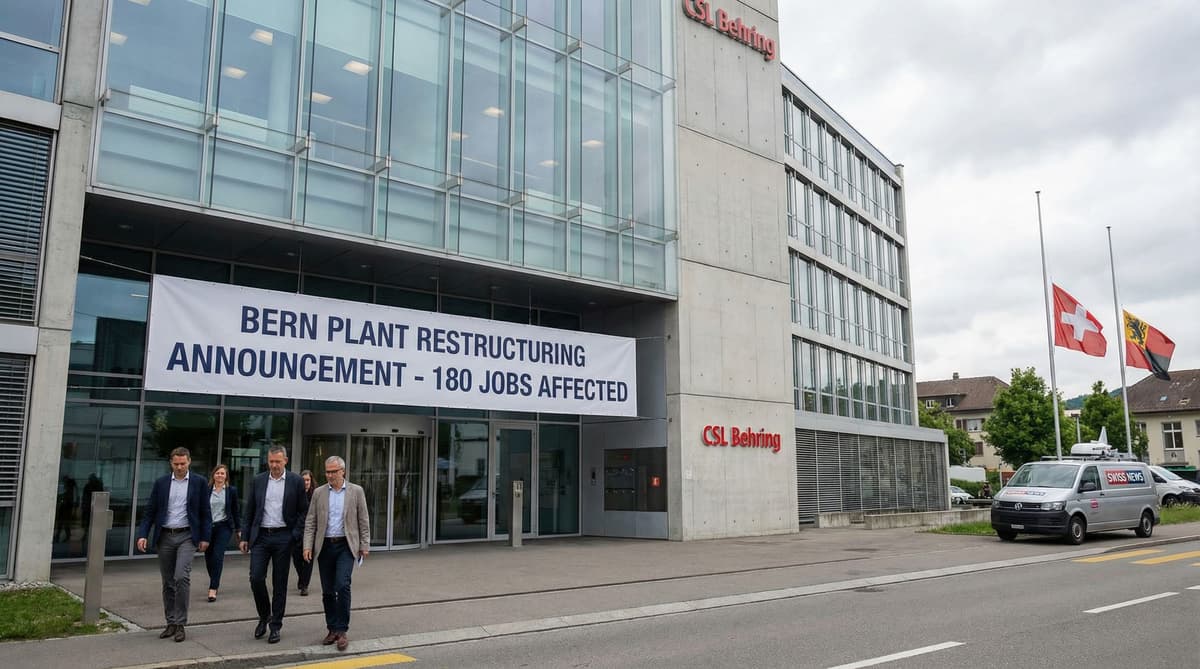
A staggering blow has landed on Bern’s industrial landscape as pharmaceutical giant CSL Behring prepares to slash its workforce at the Wankdorf facility. Reports indicate that nearly 180 employees face imminent redundancy, a move that shakes the foundations of one of the capital's key employers. This is not a minor adjustment; it is a significant contraction affecting roughly 10% of the site's 1,800-strong workforce.
The announcement shatters the quiet stability of the Swiss pharma sector, sending shockwaves through the local economy. While CSL Behring has remained tight-lipped on the exact headcount, their confirmation of a mandatory consultation procedure serves as a grim admission that the cuts are substantial. The company asserts these measures are critical "in order to be successful in the long term," but for the workers in Bern, the immediate future looks increasingly volatile. The scale of these reductions signals a harsh pivot from expansion to austerity, forcing the region to grapple with the reality of corporate downsizing in a high-value sector.
Global Directives Trigger Local Pain
The tremors felt in Bern are the direct result of a seismic shift originating from CSL Limited’s Australian headquarters. Last August, the parent company declared an aggressive strategy to slash its global workforce by up to 15%, a directive that is now crashing down on its Swiss operations. This is a calculated, top-down restructuring designed to streamline operations across all international sites, and Bern has not been spared.
CSL is executing a ruthless efficiency drive to "secure our role as a reliable partner in the healthcare sector worldwide." The disconnect between global corporate strategy and local employment stability is stark. While the global entity chases leaner margins and optimized output, the Bern facility confronts the tangible human cost of these high-level decisions. The company has stated that "various functions" will be gutted, indicating a sweeping reduction that goes beyond mere administrative trimming. This is a systemic overhaul, driven by international market pressures that care little for cantonal borders.
Mandatory Consultation Exposes Severity of Cuts
The sheer magnitude of the planned layoffs has triggered a mandatory consultation procedure, a legal safeguard activated only when redundancies reach critical levels. Under Swiss labor law, companies with over 300 employees must initiate this process if they plan to dismiss more than 30 staff members. By acknowledging this threshold has been crossed, CSL Behring has effectively confirmed the severity of the situation.
This legal requirement forces the company to pause and engage, but it also highlights the gravity of the restructuring. We are witnessing a procedural red alert. The consultation period offers a narrow window for dialogue, yet the trajectory seems set. With 1,800 employees currently on site, the potential loss of 180 positions represents a dramatic reduction in capacity. The invocation of this procedure strips away any ambiguity: CSL is preparing for a major exodus of talent, and the clock is now ticking for the affected workforce.
Strategic Consolidation Favors Zurich Hub
In a move that further isolates the Bern facility, CSL Behring is aggressively consolidating its intellectual capital. The company has previously signaled that its research and development (R&D) department in Bern will be merged with a unit in Zurich. This migration of high-value roles from the capital to Zurich underscores a strategic realignment that prioritizes centralization over regional diversity.
Bern is effectively losing a vital organ of its pharmaceutical anatomy. By shifting R&D—the engine of future innovation—to Zurich, CSL is reshaping its Swiss footprint in a way that diminishes Bern's status as a research hub. This is not just about cutting costs; it is about relocating the brainpower of the organization. While Zurich gains strength as a consolidated center of excellence, Bern is left to grapple with a hollowed-out operational structure. The message is clear: efficiency demands proximity, and for CSL, the future of innovation lies in Zurich, not Wankdorf.
Switzerland's Industrial Outlook Under Pressure
While the Swiss economy managed a slight 0.2% growth at the tail end of 2025, the developments at CSL Behring cast a long shadow over the industrial outlook for 2026. This restructuring serves as a potent reminder that even Switzerland's most robust sectors—pharmaceuticals and life sciences—are not immune to global headwinds. The "Swiss finish" of stability is being tested by the brutal realities of international corporate strategy.
As CSL Behring recalibrates, the broader question looms: Is this an isolated incident or a harbinger of a tightening labor market in the pharma sector? The loss of 180 skilled positions in Bern removes significant purchasing power and technical expertise from the local economy. Switzerland remains a global powerhouse, but as major players like CSL prioritize consolidation and efficiency over headcount, the nation's workforce must adapt to a more volatile corporate environment. The era of guaranteed tenure in big pharma is fading, replaced by a landscape where agility and efficiency dictate survival.