Solothurn
Bison incident highlights the risks of Switzerland’s rewilding projects
A European bison injured a ranger at a Solothurn enclosure after the animal was approached too closely and became cornered. The article should explain the project’s conservation aims, the safety protocol and what the incident reveals about reintroducing large wild herbivores to Switzerland.
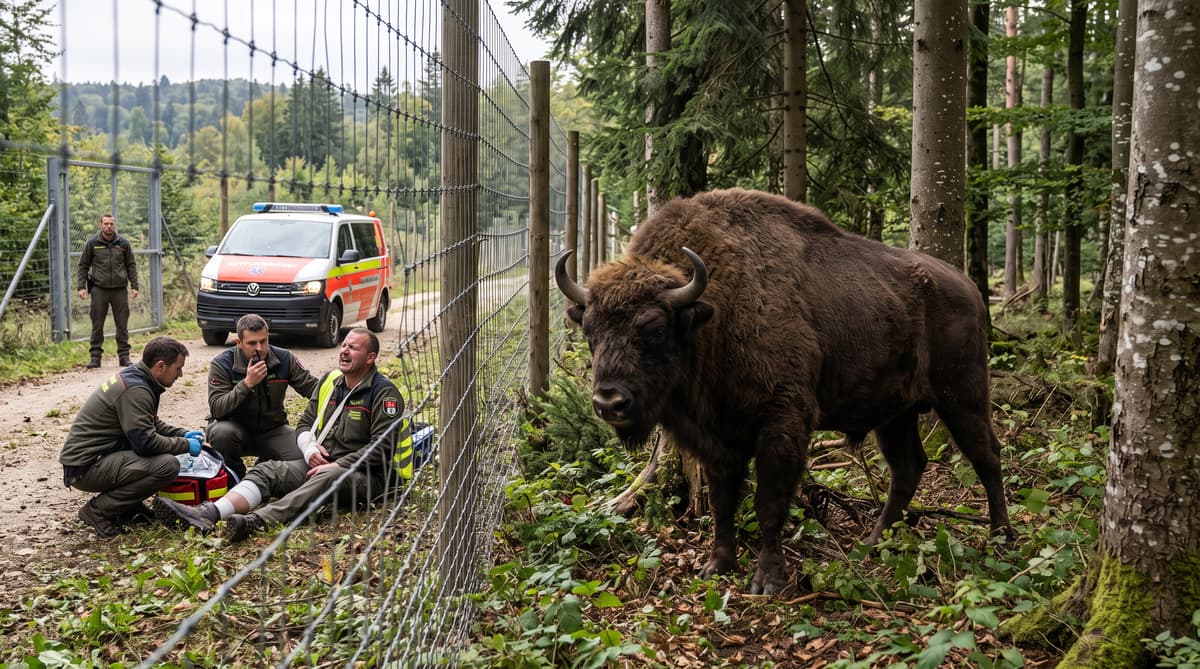
Bison injury puts rewilding safety in focus
A bison bull injured a ranger in Welschenrohr on Monday afternoon, bringing the practical hazards of Switzerland’s rewilding debate into sharp focus. The man approached the animal in the test enclosure and tried to drive it away. Rega then airlifted him to hospital.
According to the Wisent im Thal association, the ranger came within one or two metres of the bull. That fell below the minimum distance set out in the project’s code of conduct. The animal did not back away. It felt cornered and knocked the ranger over as it attempted to free itself.
The incident occurred at Sollmatt, a roughly 100-hectare fenced site in the canton of Solothurn. The enclosure is part of a live conservation experiment, not a conventional zoo. People can still enter the area without restriction, and farming and forestry continue there.
That arrangement places wild animal behaviour alongside everyday rural activity. The injury has therefore raised a practical issue for the project: whether safety rules can protect people when a powerful, free-moving herbivore shares a landscape used by rangers, farmers, foresters and walkers.
Distance rules meet animal instinct
The project’s safety protocol sets a minimum distance between people and bison, and the ranger’s approach breached that rule. The association said the experienced ranger wanted to scare the bull away, a decision that brought him into the animal’s immediate space.
The sequence matters. The bull did not charge from a distance in an unexplained attack. It stayed in place when approached, became cornered and struck while trying to get out. The association described the response as defensive and said bison do not normally behave aggressively towards humans.
That explanation does not reduce the seriousness of the injury. It shows why distance rules must guide action even when staff know the animals well. A bison can weigh hundreds of kilograms and move quickly over short distances. A person attempting to control its movement has little margin for error once the animal loses an escape route.
The episode also tests how the code of conduct works in the field. Rules must be clear enough to follow under pressure, and everyone working in the enclosure must know who is authorised to move animals, when access should stop and how people can leave without pushing a bison into a corner. The source report does not say whether the project will change its procedures after the incident.
The Jura becomes a proving ground
Switzerland lost the European bison in the Middle Ages, and the Welschenrohr herd is testing whether the species can return to the Jura as a wild animal. The Wisent im Thal association began investigating that possibility in 2022 and plans to continue the trial until 2027.
The enclosure allows researchers and project managers to observe how bison use the landscape and how their presence fits with existing human activity. Its size, around 100 hectares, gives the animals room to move while keeping the herd within a managed area. The site belongs to the municipality of Solothurn and to the ranger involved in the accident, according to the report.
The conservation case rests on restoring a native large herbivore and understanding its role in forest and meadow ecosystems. The source material does not provide a final assessment of ecological effects, population targets or a timetable for release into an unfenced landscape. Those questions remain part of the investigation.
The injury adds a human dimension to that work. Any future return would have to account for more than habitat and animal health. It would also need reliable arrangements for encounters with hikers, landowners, forestry workers and emergency services across a densely settled country.
A shared landscape demands shared rules
The enclosure remains open to the public without restriction, even as agricultural and forestry activities continue inside it. That combination makes the Welschenrohr trial a useful test of how rewilding can operate in an occupied landscape.
Public access creates opportunities for people to see the animals, but it also increases the number of possible encounters. Walkers may not understand bison body language or the danger of blocking an animal’s route. Workers may face urgent tasks that require them to enter areas occupied by the herd. A protocol designed for experts must also be understandable to visitors who encounter a bison unexpectedly.
The source report identifies the minimum distance rule, yet it does not detail the full set of public instructions, warning signs, access controls or emergency procedures. Those details will matter as the project evaluates whether a free-ranging population could function in the Jura.
The incident also underscores a familiar Swiss land-use challenge. Conservation projects must fit around municipalities, private property, farms, forests and recreation. Fencing can contain animals during a trial, but it cannot by itself eliminate risk. The management system must account for people entering the same space and for situations in which an animal refuses to move.
The trial must measure safety too
The project now has a clear incident to examine before its planned 2027 endpoint. The available account points to a chain of preventable risk: a person approached too closely, the bull lost room to withdraw and the animal reacted while escaping. The association’s explanation places responsibility on a misjudgement rather than on deliberate aggression.
For Switzerland, the lesson is operational. Reintroducing a large herbivore requires protocols that work during routine maintenance as well as unexpected encounters. Rangers need authority to suspend work or close an area when animals occupy a route. Visitors need prominent, consistent instructions. Managers need a way to monitor compliance and record near misses, not only injuries.
The incident does not settle whether bison can return to Swiss forests. It does show what the trial must measure alongside ecological performance: how animals respond to human activity, how people behave around them and whether the surrounding institutions can manage those interactions.
Welschenrohr’s experiment continues in a landscape where nature recovery and daily work already overlap. The next phase will reveal whether its safety framework can keep pace with the ambition to make room for a species absent from Switzerland for centuries.