Science
Swiss Study: AI Weather Models Fail When It Matters Most, Miss Extreme Events
While artificial intelligence is revolutionizing meteorology with faster forecasts, a new study from the University of Geneva reveals a critical flaw: the most advanced AI models consistently fail to predict extreme weather events, a significant weakness with implications for public safety and infrastructure protection.
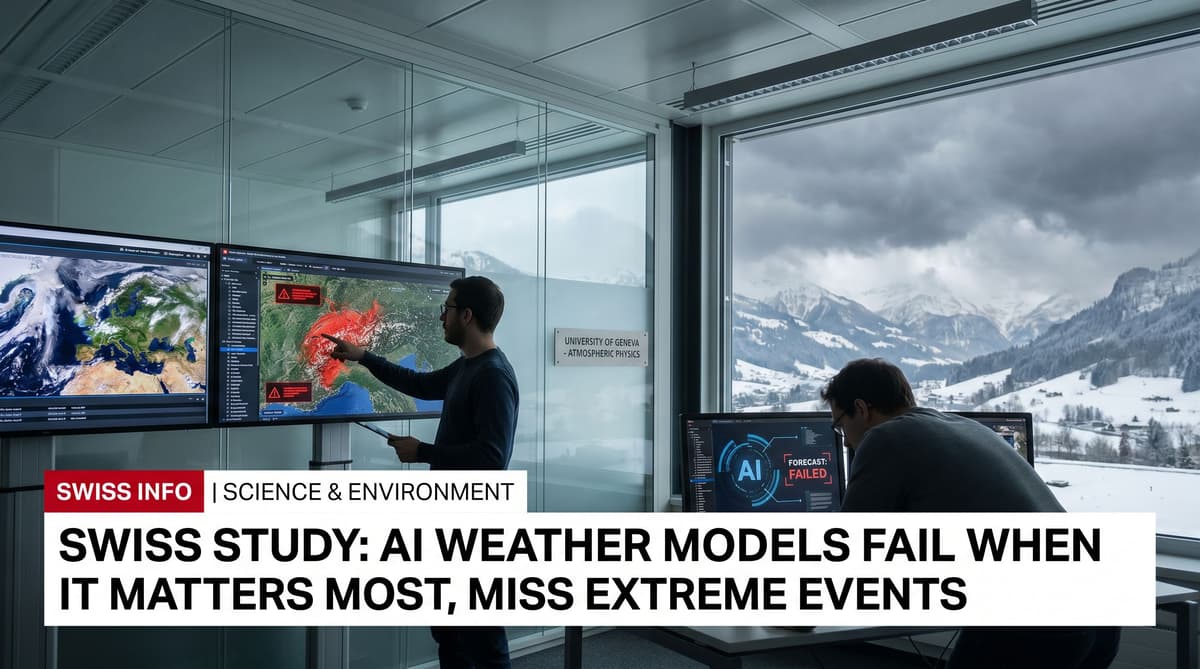
Artificial Intelligence is failing precisely when Swiss citizens need it most. While tech giants promise a revolution in meteorology, a groundbreaking study from the University of Geneva reveals a staggering reality: the world's most advanced AI models are systematically blind to extreme weather. As climate change accelerates, the gap between digital convenience and physical reality has become a matter of life and death. These models—hailed as the future of forecasting—consistently underestimate cold spells, heat peaks, and violent wind events that threaten Swiss infrastructure and public safety. The verdict from the University of Geneva is unequivocal: when the weather turns historic, the AI turns unreliable. This isn't just a technical glitch; it is a fundamental breakdown in the systems designed to protect our communities from the escalating volatility of the natural world.
The Statistical Blind Spot Exposed
Three of the global titans of AI forecasting—GraphCast, Pangu-Weather, and Fuxi—have been unmasked by Swiss researchers. The study, published in Science Advances, demonstrates that these models operate on a logic of historical repetition that cannot account for the unprecedented. Because machine learning relies on what has already happened, it remains trapped in the past. In contrast, extreme weather is, by definition, an outlier. The data shows that AI models not only predict the intensity of these events too weakly, but they also predict their occurrence far too rarely. For a nation like Switzerland, where alpine microclimates can shift with lethal speed, relying on a system that ignores 'black swan' events is a gamble we cannot afford. The AI is learning from a world that no longer exists, failing to grasp the 'new normal' of climate-driven extremes.
Physics Defeats Algorithms in Crisis
Physics does not change, even when the climate does. This is the decisive advantage held by traditional physical models like the HRES system from the European Centre for Medium-Range Weather Forecasts (ECMWF). While AI searches for patterns in old data, physical models simulate the atmosphere using immutable laws of thermodynamics and fluid mechanics. These laws remain true even during a once-in-a-century storm that an AI has never 'seen' before. The University of Geneva researchers highlight that this fundamental difference is why traditional models can calculate extreme situations that have no historical precedent. In the high-stakes environment of Swiss civil protection, the reliability of a physics-based calculation outweighs the speed of an algorithmic guess. The 'Achilles’ heel' of machine learning is its inability to innovate when faced with the unknown, a flaw that becomes glaringly obvious during record-breaking heatwaves or unprecedented floods.