Switzerland
Swiss neutrality vote becomes a test of sanctions policy and foreign influence
Swiss voters will decide on September 27 whether to constitutionalise a stricter interpretation of neutrality, including limits on sanctions. The campaign is attracting reported Russian influence efforts and raises questions about Switzerland’s foreign-policy autonomy.
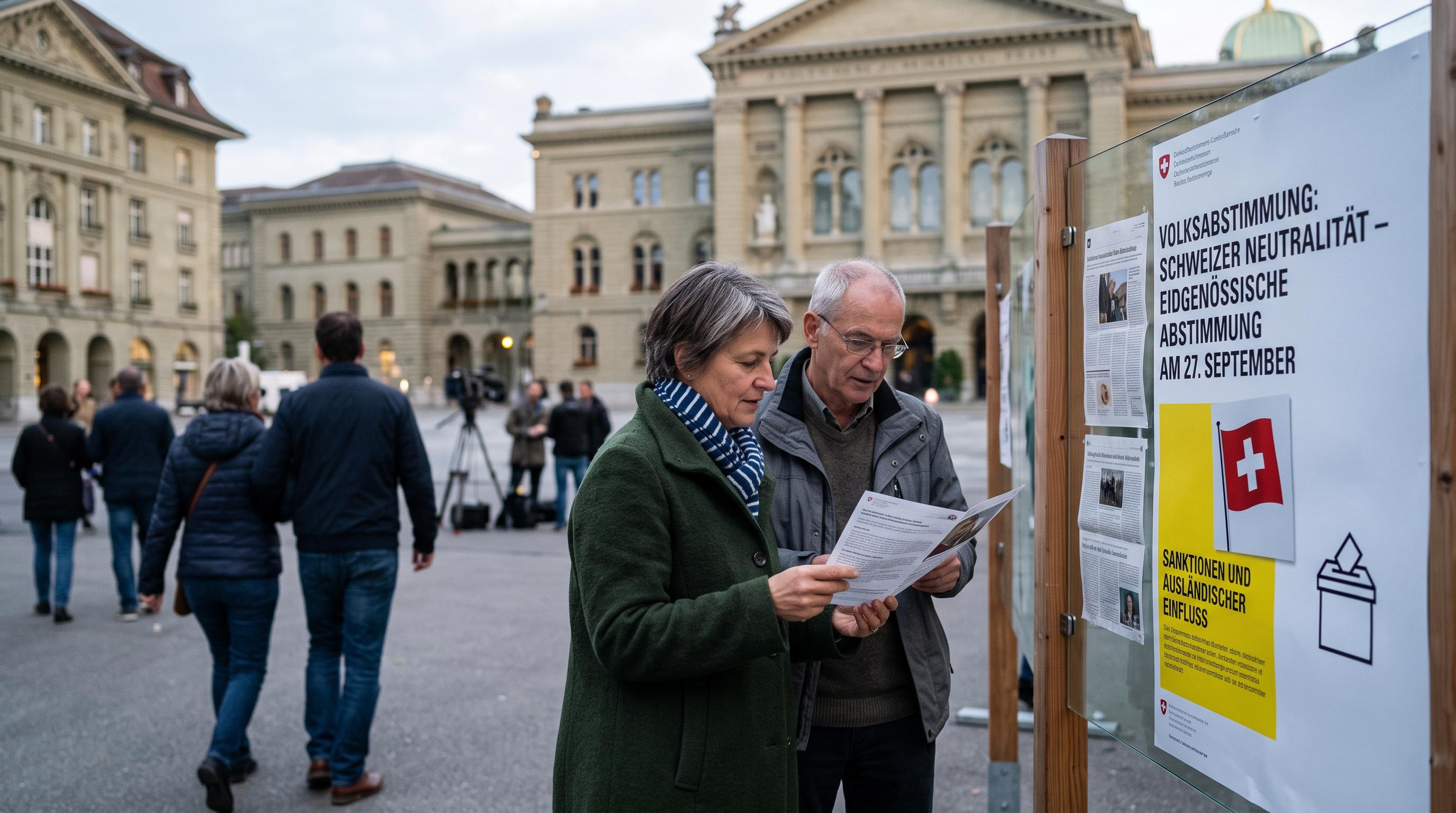
Voters Put Neutrality on Trial
On September 27, Swiss voters will decide whether neutrality should constrain the country's response to war. The popular initiative would write a stricter definition of perpetual and armed neutrality into the Constitution, with direct consequences for sanctions policy and foreign relations.
The vote arrives after Switzerland adopted the European Union's sanctions against Russia following the invasion of Ukraine in February 2022. Supporters say those measures damaged Switzerland's credibility as a mediator and weakened a principle that has protected the country for generations. Opponents argue that neutrality must leave room for Switzerland to respond when international law is breached.
The campaign has also drawn scrutiny from abroad. Russian state media have published material sympathetic to the initiative, and Russian Foreign Ministry spokesperson Maria Zakharova has expressed support for it. Swiss security officials say foreign disinformation and state sponsored influence efforts directed at Switzerland are increasing.
That combination gives the referendum a reach beyond the wording of a constitutional amendment. It will test whether Swiss voters view sanctions as a breach of neutrality, or as a sovereign instrument used to defend the rules on which Switzerland's security and prosperity depend.
Follow the Money Behind the Ballot
Nearly 2,790 Russian individuals, companies and organisations are under Swiss sanctions. The measures freeze assets held in Switzerland, restrict access to economic resources and limit entry or transit for sanctioned people, including Russian President Vladimir Putin and Foreign Minister Sergei Lavrov. An exception applies when sanctioned individuals take part in peace negotiations in Switzerland.
As of July 1, 2026, Swiss authorities had frozen CHF 8.5 billion in financial assets and 14 properties, alongside vehicles, aircraft, artworks, furniture and musical instruments. The figures illustrate the practical weight of a policy that can appear abstract in constitutional debate.
Switzerland followed almost all of the European Union's 21 sanctions rounds against Moscow. The measures include a price cap on Russian oil, bans on Russian coal, vodka and diamonds, and restrictions affecting banks' access to the SWIFT payment system. Because Russia can veto action at the United Nations Security Council, there is no comprehensive UN sanctions regime against Moscow.
The initiative would exempt Switzerland's UN obligations, according to the campaign's critics and supporters, while creating a broad constitutional barrier against sanctions imposed on states involved in armed conflicts. That provision makes the referendum a direct vote on the future scope of Swiss economic statecraft.
Measure Switzerland's Sanctions Leverage
Before the war, Switzerland handled about 75% of Russian coal trade and 60% of Russian oil trade. Those flows made the country a major commercial hub for Russian commodities and gave Bern a substantial economic connection to Moscow. After the invasion, sanctions became Switzerland's principal lever for limiting the financing of Russia's war effort.
The record is contested. Russia's economy did not collapse as many Western governments expected, and Moscow redirected trade through third countries while expanding state support for wartime production. That does not settle the Swiss argument. Supporters of sanctions point to the limits they impose on finance, technology and access to Western markets. Critics point to their uneven economic impact and the cost to Switzerland's traditional commercial neutrality.
Kevin Grangier, secretary general of Pro Switzerland, says adopting EU sanctions weakened Switzerland's ability to mediate international conflicts. Laurence Fehlmann Rielle, a Social Democratic parliamentarian, says the country needs flexibility if it is to promote peace and respond to aggression.
The dispute reaches into Geneva's diplomatic identity, Zurich's financial sector and commodity trading networks that have long linked Switzerland to global markets. A constitutional ban could narrow the government's room to adjust policy when wars and alliances change.
Track the Foreign Influence Campaign
Russian actors have entered the campaign's information space as Swiss voters weigh the initiative. RT.DE has published several articles criticising the Federal Council and supporting the neutrality proposal. Some were attributed to a person named Hans Ueli Läppli, although reporting found no identifiable journalist by that name. The name echoes a fictional Swiss soldier created by entertainer Alfred Rasser.
Russian officials have also promoted the initiative directly. Ulrich Schmid, a professor of Eastern European studies at the University of St Gallen, told SRF that Moscow wants to present the war in Ukraine as a normal conflict between two states. A constitutional neutrality rule that blocks sanctions would support that framing, he said.
The influence effort may not determine the result. Schmid expects it to have limited immediate effect, while warning that repeated activity can polarise debate and weaken confidence in democratic institutions over time. The method relies heavily on social media, where campaign messages can move quickly across language regions and political communities.
The Federal Council created a working group at the end of 2025 to improve coordination against foreign interference. Parliament is considering stronger monitoring, greater transparency about foreign actors and additional resources or powers for intelligence services. Those proposals raise their own questions about oversight and free expression in a direct democracy.
Prepare for the Foreign Policy Aftershock
The result will define how much freedom future Swiss governments retain during international crises. A yes vote would give constitutional status to a stricter neutrality doctrine and could limit sanctions against countries involved in armed conflicts, except where Switzerland acts under United Nations obligations. The practical interpretation would still depend on the courts, Parliament and the Federal Council.
A no vote would preserve the current framework, under which the government can adopt sanctions it considers compatible with Swiss neutrality and national interests. It would also leave open the debate over whether Bern moved too quickly toward the EU after Russia's invasion, and whether Switzerland can remain a credible mediator while imposing economic pressure.
The debate has exposed a persistent tension in Swiss foreign policy. The country wants the protection and diplomatic access associated with neutrality, while its financial centre, commodity traders and international institutions tie it closely to global conflicts. Voters must assess how those interests fit together in a constitutional text that could last for decades.
The campaign will be watched closely in Bern, Geneva, Zurich and abroad. Its immediate subject is sanctions against Russia. Its longer effect will be measured by how confidently Switzerland can act when neutrality, security and economic power point in different directions.