Avalanche
Avalanche Crisis Grips Swiss Alps: Fatality, Train Derailment, and AI Response
Following a week of heavy snowfall and a maximum-level avalanche warning, Switzerland is grappling with a skier's death and a train derailment. While authorities manage the immediate danger, researchers are developing an AI model that 'listens' for seismic signals to predict slides.
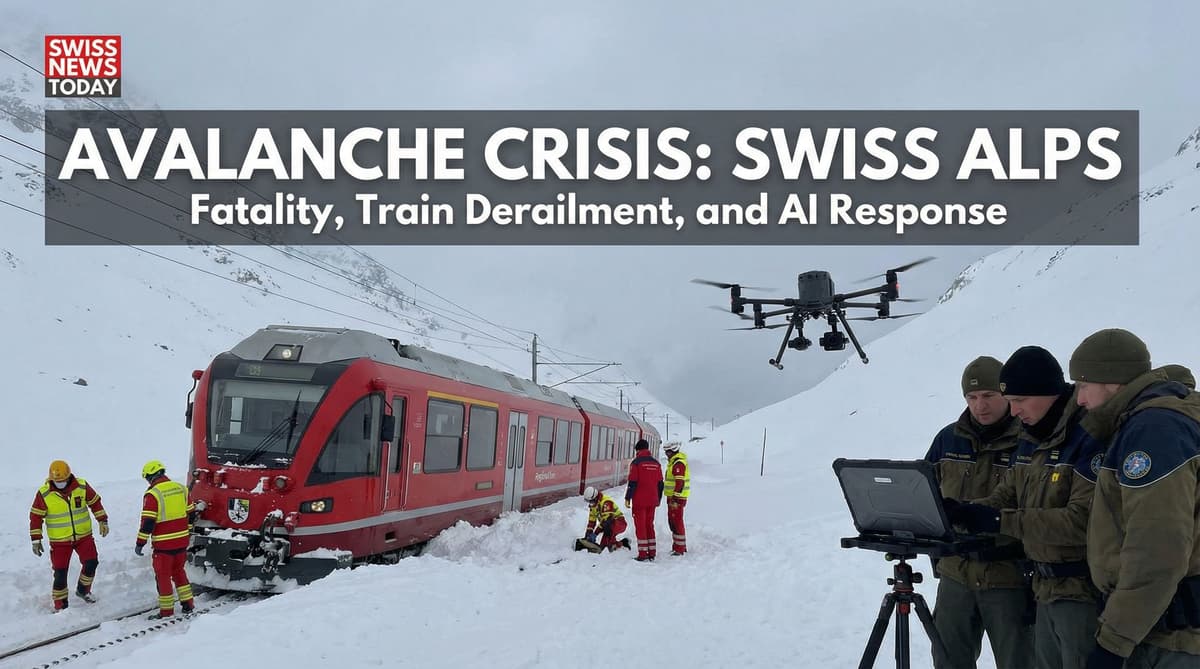
Nature has delivered a crushing blow to the Swiss transport network, turning a routine commute into a scene of chaos. A regional train on the Ferden–Goppenstein–Steg line was struck by a sliding mass of snow early Monday, derailing the carriage and injuring five passengers. This incident in Goppenstein is the most tangible evidence of the extreme volatility currently gripping the Alps. Following the crash, the Federal Institute for Snow and Avalanche Research (SLF) escalated the threat level to a critical 5 out of 5—the highest possible warning—for parts of the Valais region.
This is not merely a weather event; it is a public safety emergency. While the danger level has since fluctuated between 'high' (Level 4) and 'very high' (Level 5), the message from authorities is unambiguous: the snowpack is unstable, unpredictable, and deadly. The derailment serves as a stark reminder that even established infrastructure is not immune when the Alps are in this state of flux. With emergency crews working under perilous conditions, the immediate focus remains on stabilizing the affected rail lines and preventing further casualties in a week that has already proven disastrous.
Tragedy in Graubünden: Father Killed, Son Rescued in Season's 13th Fatality
The crisis in the mountains has claimed yet another life, bringing the season's death toll to a grim 13. In a heartbreaking incident on Tuesday afternoon, a 49-year-old father was killed while skiing off-piste in Parsonz, Graubünden. While rescue teams successfully pulled his 15-year-old son from the suffocating snow, the father could not be revived despite immediate resuscitation attempts. This tragedy marks the second fatality in Graubünden in less than 48 hours, following the death of a 38-year-old snowboarder in Davos on Sunday.
The lethal combination of fresh snow on top of weak, 'sugary' layers formed during previous dry spells has created a hair-trigger environment. The SLF reports that the snowpack is currently so fragile that the weight of a single skier is enough to fracture the surface and release a slide. These are not freak accidents; they are the result of specific, high-risk conditions that are currently prevalent across the eastern and southern Alps. As families grieve, the cantonal police have opened an investigation, but the verdict from the mountain is already clear: venturing off-marked pistes right now is a gamble with the highest stakes imaginable.
Alpine Gridlock: 80cm Snowfall Severs Critical Transport Arteries
A staggering 80 centimeters of fresh snow has pummeled mountain areas in recent days, effectively paralyzing travel to some of Switzerland's most iconic destinations. The logistical fallout is severe. Access to the Lötschental Valley was completely severed over the weekend, and while the road to Wiler has reopened, the situation remains critical. The Goppenstein railway line—a vital artery—remains closed following the derailment, with disruptions expected to last until Saturday morning at the earliest.
For the tourism-dependent cantons, this is a nightmare scenario. Road access to major hubs like Saas Fee and Zermatt is currently blocked or severely restricted, trapping tourists and halting commerce. While replacement bus services are running between Visp and Goppenstein, the sheer volume of snow has rendered standard schedules obsolete. This is not just a disruption; it is a full-scale blockade by nature. Travelers are being urged to exercise extreme caution and patience, as the clearing of these routes is contingent on the stability of the slopes above them.