agriculture
Organic Farming Achieves 85% of Conventional Yields in Swiss Study
47-year Swiss trial reveals organic farming reaches 85% of conventional agriculture yields while using significantly fewer fertilizers and pesticides.
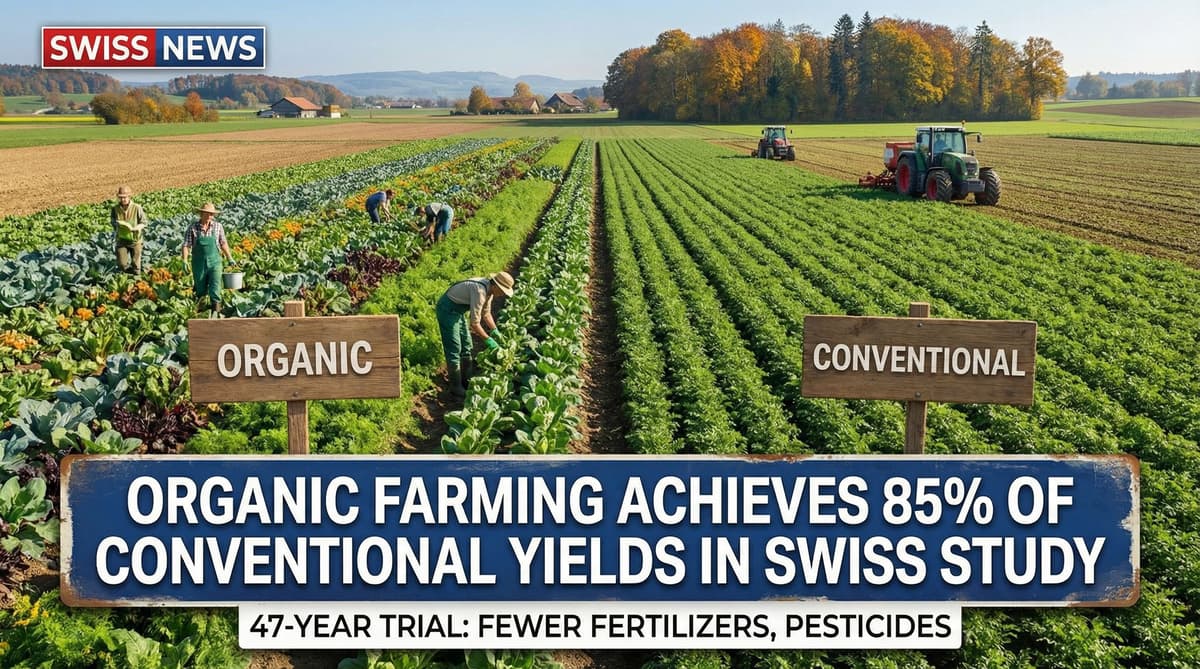
The myth that organic farming cannot compete on the global stage has been shattered by nearly half a century of rigorous Swiss science. In a landmark revelation from the 'Methuselah of field trials' in Therwil, Basel-City, data confirms that organic agriculture is punching well above its weight, achieving a staggering 85% of conventional yields. This is not a short-term anomaly; it is the result of the DOK trial, a globally unique experiment running continuously since 1978.
Led by the Research Institute of Organic Agriculture (FiBL) and Agroscope, this study confronts the skepticism surrounding sustainable farming with hard data. While critics often cite yield gaps as a dealbreaker, the Swiss findings suggest a different narrative: high productivity is possible without the chemical deluge. The trial proves that the trade-off between yield and sustainability is far narrower than previously feared, positioning Swiss organic methods as a formidable blueprint for the future of global food security.
Slashing Inputs: The 92% Pesticide Drop
The most shocking statistic from the DOK trial isn't what was grown, but what was left out. Organic systems maintained their impressive yields while utilizing a mere 8% of the pesticides used in conventional agriculture. This represents a massive 92% reduction in toxic load, drastically lowering the risk of pollutants contaminating Switzerland's water, food, and animal feed.
Furthermore, the study reveals that organic farmers are achieving these results while using only 65% of the nitrogen fertilizers required by their conventional counterparts. This efficiency is revolutionary. Conventional agriculture is grappling with an addiction to chemical inputs to squeeze out that final 15% of yield, while organic methods demonstrate a far superior input-to-output ratio. The data screams a clear message: the chemical intensity of modern farming is yielding diminishing returns, while organic systems are proving to be leaner, cleaner, and remarkably resilient.
Crop Wars: Soy Triumphs While Wheat Struggles
Not all crops are created equal under the organic banner, and the Swiss trial exposes stark contrasts in performance. In a surprising victory for sustainable protein, soy yields are identical whether grown organically or conventionally. This equality challenges the assumption that organic methods always lag behind. For soy, the chemical advantage is nonexistent.
However, the reality for staples like wheat and potatoes is more complex. These crops grapple with greater losses in organic systems, highlighting the biological challenges that still exist without synthetic aids. Additionally, yield stability remains a critical hurdle; organic farming faces greater fluctuations year-over-year. While the averages are high, the consistency is lower, presenting a tangible risk that farmers must manage. The data paints a nuanced picture: organic is a powerhouse for certain crops, but for others, the battle for yield parity continues.