culture
Lausanne Cathedral Marks 750 Years with Federal Celebration
Historic Lausanne Cathedral celebrates 750th anniversary with ceremony featuring Federal Councillor Guy Parmelin, highlighting its cultural and institutional significance.
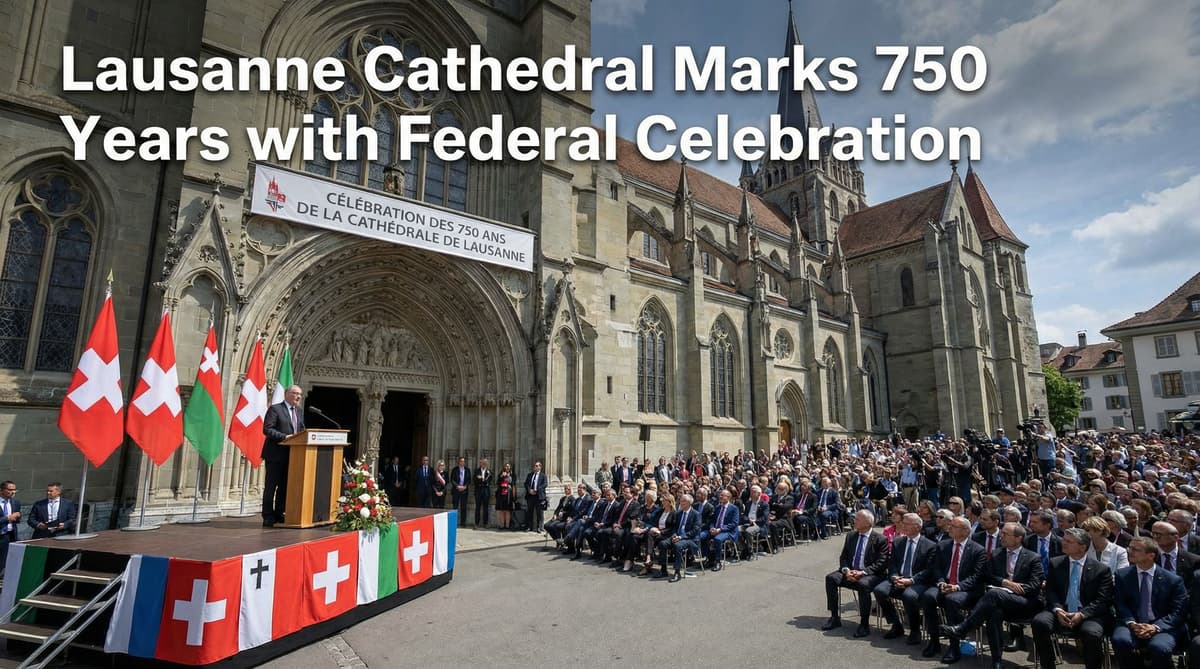
Three quarters of a millennium. That is the staggering weight of history that descended upon Lausanne this week as the city marked the 750th anniversary of its cathedral's consecration. In a display of federal reverence, Federal Councillor Guy Parmelin stood before the Gothic masterpiece, declaring it a "symbol of unity and influence" for the entire Vaud community. This was not merely a birthday party; it was a powerful assertion of Swiss heritage.
The event commemorates the pivotal moment on October 20, 1275, when Pope Gregory X, flanked by Emperor Rudolf of Habsburg, officially inaugurated Notre-Dame de Lausanne. Today, the echoes of that imperial grandeur returned. Parmelin, speaking with the authority of the Federal Council, hailed the edifice as a "place of life" that commands an "inevitably admiring and reverent regard." The atmosphere inside the cathedral was electric, charged with the realization that this structure has witnessed the rise and fall of empires, yet stands resolute as a beacon of Swiss stability.
Gothic Mastery: Preserving a Vaudois Icon
While the consecration is the headline, the sheer engineering prowess required to build this icon demands recognition. Construction spanned a grueling 65 years, from 1170 to 1235—a testament to medieval determination that dwarfs modern timelines. Christelle Luisier, President of the Vaud government, seized the moment to characterize the cathedral as a guardian that "watches over Lausanne." Her words underscored a critical mandate: this is a treasure that must be aggressively preserved.
Luisier’s commitment was absolute. She emphasized the state's unwavering determination to protect this "presence and landmark" for future generations through relentless renovation campaigns. The cathedral is not a static museum piece; it is a living component of the Vaudois landscape and inner life. As the titular organist Jean-Christophe Geiser filled the vast nave with musical interludes, the connection between the ancient stone and the living community was undeniable. The structure remains a dominant force, demanding both respect and constant care to ensure it survives another seven centuries.
Defying Superficiality: A Challenge to the Modern Age
In a sharp rebuke to the fleeting nature of the digital era, Philippe Leuba, president of the Synodal Council, framed the cathedral as a defiant challenger to modern culture. He described the edifice as a bulwark against "immediacy and superficiality," labeling these trends as the "two scourges of our time." His speech struck a chord, positioning the cathedral not just as a building, but as a philosophical counterweight to the accelerated pace of 21st-century life.
Leuba did not shy away from local wit, drawing laughter from the distinguished audience by comparing the decades-long construction of the cathedral with the notorious delays currently plaguing Lausanne’s train station. It was a moment of levity that highlighted a serious point: the medieval builders possessed a patience and vision that the modern world often lacks. This contrast serves as a stark reminder that true greatness requires time. The ceremony, concluding with a blessing from Pastor Line Dépraz, reinforced the cathedral's role as a spiritual anchor in a rapidly shifting world.