Science
Swiss researchers join investigation of asteroid-deflection test
The European Space Agency’s Hera probe has arrived at the asteroid moon Dimorphos to study the impact of NASA’s 2022 planetary-defence test. Swiss researchers are involved in analysing how the collision changed the asteroid’s motion and what that means for future deflection missions.
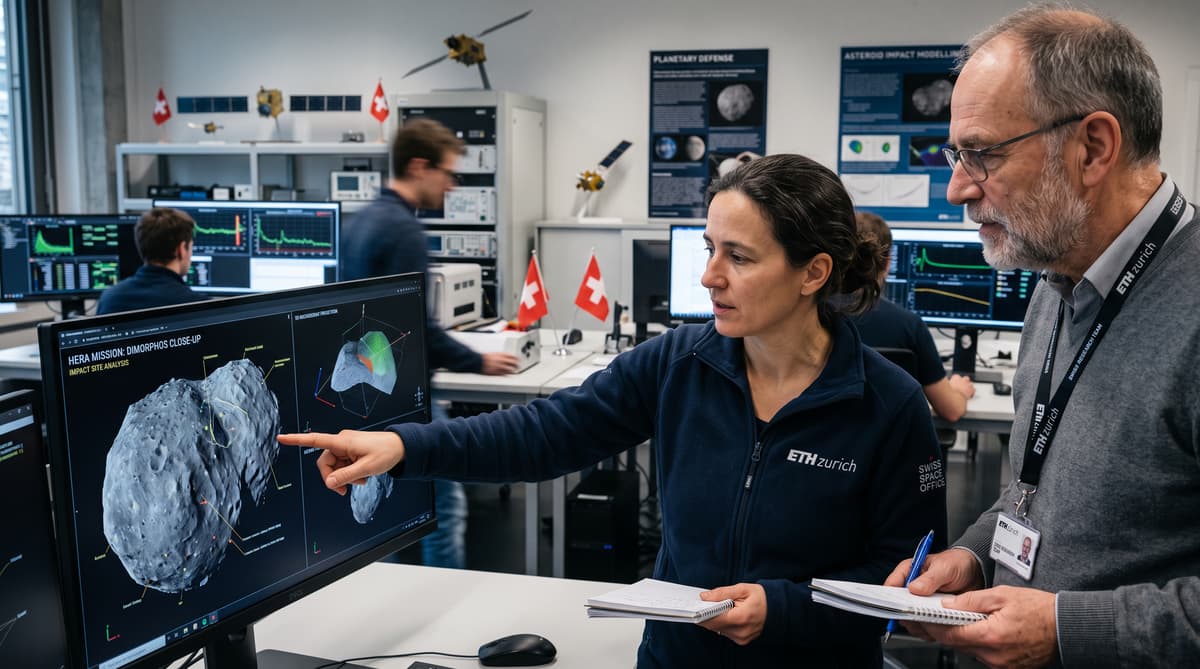
Hera is closing in on Dimorphos to inspect the aftermath of a deliberate asteroid strike. The European Space Agency probe has reached the asteroid system, where researchers will examine how NASA’s 2022 collision changed the small moon and its orbit around the larger asteroid Didymos.
The test sent NASA’s DART spacecraft into Dimorphos in September 2022 at about 6.1 kilometres per second, or nearly 22,000 kilometres per hour. The impact shortened Dimorphos’s orbital period from 11 hours 55 minutes to around 11 hours 22 minutes, demonstrating that a spacecraft can alter an asteroid’s motion.
Now the Bern research team involved in modelling that collision is preparing to compare its calculations with observations. Hera’s approach is a demanding stage of the mission, University of Bern astrophysicist Martin Jutzi told Keystone-SDA. The probe is expected to begin its Early Characterisation Phase in November, when it will be about 30 kilometres from Dimorphos and close enough to send researchers their first usable images. Those observations will turn the original impact test into a more detailed investigation of what happened to the asteroid itself.
Measure What the Collision Changed
The orbital change is clear, but its cause is still being measured in detail. DART’s collision altered Dimorphos’s orbit, yet the change in orbital period alone cannot show exactly how much of the spacecraft’s energy and momentum went into moving the asteroid moon. Researchers also need to understand how the impact reshaped the body and how much material was thrown outward.
That distinction matters for planning a future deflection mission. A spacecraft’s impact could move an asteroid partly through the force of the collision and partly through the recoil from material blasted off its surface. The balance depends on the asteroid’s mass and internal structure. Jutzi said Hera’s results will help researchers estimate the energy and momentum required to shift an asteroid of a given mass, and how efficiently a collision can produce that movement.
Dimorphos measures about 160 metres across and orbits Didymos like a moon. Hera is expected to move from roughly 30 kilometres away during its initial characterisation to around 10 kilometres by December. Images and other measurements from those closer passes will help investigators examine the impact’s consequences beyond the change in orbital timing.
Put Bern’s Asteroid Model to the Test
Bern researchers predicted that Dimorphos may be a loosely bound pile of debris, not a solid block of rock. A team led by Martin Jutzi and John Wimarsson at the University of Bern, with Sabina Raducan of the International Space Science Institute in Bern, simulated the DART impact on a computer. Their calculations suggested the collision could have deformed the asteroid moon as a whole, rather than leaving only a conventional crater.
Hera’s close-up observations are expected to test that prediction. If the team’s model is borne out, the findings would show why an asteroid’s internal structure matters when scientists calculate how a deflection attempt might work. Two objects of similar size could respond differently if one is solid and the other is made of loosely held fragments.
A key missing measurement is Dimorphos’s mass. Jutzi said knowing it would allow the team to quantify how much momentum and energy DART transferred. Hera’s images are due to provide an initial assessment of the damage, while the broader investigation will help establish the physical properties needed to interpret the impact. For the Swiss researchers, that comparison links computer simulations developed in Bern with evidence gathered at the asteroid itself.
Turn Hera’s Findings Into Defence Plans
The larger asteroids are rare, but their potential consequences make accurate deflection planning important. Jutzi said objects measuring 10 to 20 metres across strike Earth statistically every few decades. Much larger bodies are less frequent: an asteroid 100 to 200 metres wide might hit every 10,000 to 20,000 years, he said, and could cause devastating regional or even global consequences.
Those estimates underline why planetary defence depends on more than proving that a spacecraft can change an asteroid’s path. Scientists need to know the target’s mass, composition and response to impact before they can calculate how much force a mission would need to apply. Hera’s findings will help researchers refine those calculations using the results of a real collision, rather than relying only on models.
The work has a direct Swiss contribution through the University of Bern and the International Space Science Institute in Bern. Jutzi’s team will use Hera’s measurements to assess how effectively DART transferred momentum to Dimorphos. That evidence can guide the design of later missions intended to alter the motion of hazardous asteroids, and help scientists judge what a deflection attempt could achieve for a particular target.