business
Glencore plans $12 billion copper investment in Argentina
Swiss-based mining giant Glencore announces major expansion of copper operations in Argentina with planned investment exceeding $12 billion, creating 2,500 jobs.
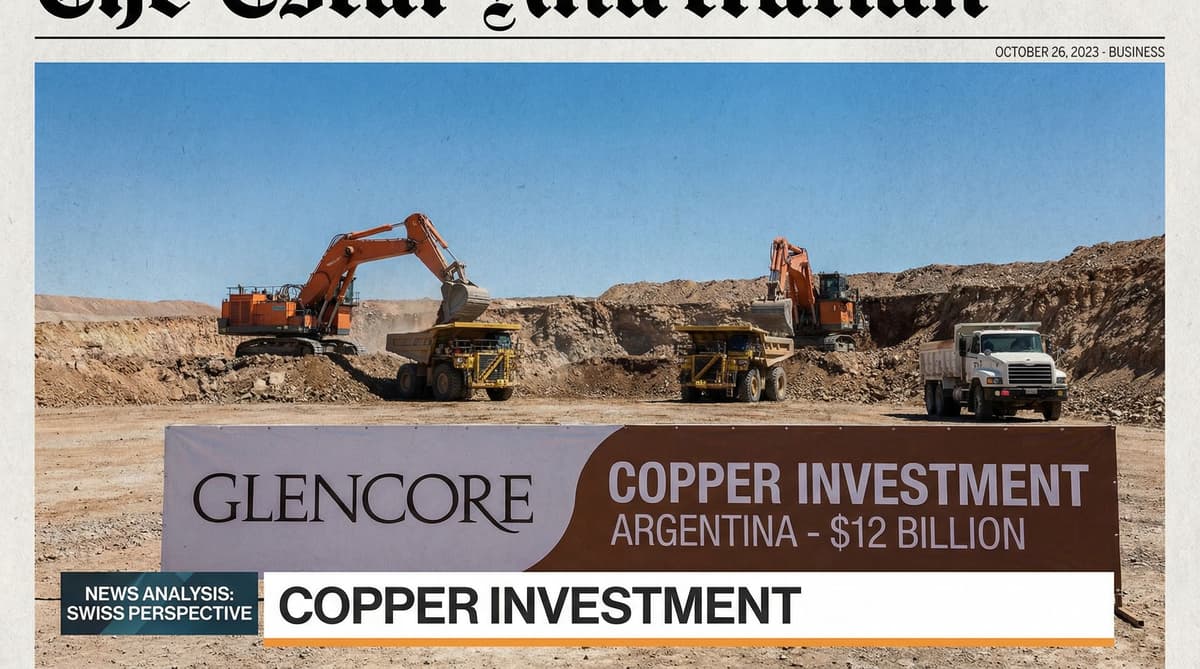
A staggering $12 billion (CHF 9.7 billion) capital injection is set to flow from Zug to the Andes, as Glencore asserts its dominance in the global copper market. The Swiss-based mining and commodities trading giant is not merely dipping a toe into Argentine waters; it is diving in with unprecedented force. This massive financial commitment signals a decisive vote of confidence in the region's mineral wealth, positioning Glencore at the forefront of the race for critical resources.
While other conglomerates hesitate in the face of global economic volatility, Glencore is charging ahead. The sheer scale of this investment—surpassing the GDP of many small nations—underscores the critical importance of copper in the company’s long-term strategy. By anchoring its future growth in South American soil, the Swiss multinational is securing a vital supply line for a world increasingly hungry for conductive metals. This is not just an expansion; it is a declaration of intent from one of Switzerland's most powerful corporate entities.
Anatomy of a Mega-Deal
The numbers are nothing short of astronomical. Glencore’s strategy hinges on two colossal production sites, with the El Pachón operation taking the lion's share of the funding. The company intends to channel a massive $8.5 billion to $10.5 billion solely into developing El Pachón, transforming it into a cornerstone of their South American portfolio. Meanwhile, the Agua Riga operations are set to receive a substantial infusion ranging between $3.5 billion and $4.5 billion.
This bifurcated investment strategy reveals a calculated approach to scaling production. By simultaneously upgrading two major sites, Glencore is diversifying its operational risk while maximizing output potential. The injection of capital is expected to modernize infrastructure, accelerate extraction rates, and solidify the logistical chains necessary to move millions of tons of earth. These are not abstract figures; they represent concrete, steel, and heavy machinery that will fundamentally alter the landscape of Argentine mining.
Capitalizing on the Milei Shift
Glencore’s timing is as precise as its engineering. The multinational has explicitly applied for these projects to benefit from the Milei administration’s aggressive programme designed to court major international investments. This move represents a strategic alignment with Argentina's shifting political tides, capitalizing on a deregulatory environment that favors heavy industry and foreign capital.
By leveraging these government incentives, Glencore is effectively reducing the friction often associated with large-scale South American mining projects. The administration’s push to revitalize the economy through foreign direct investment provides the perfect cover for Glencore to entrench its operations. It is a symbiotic maneuver: Milei gets the headline-grabbing economic win he desperately needs, and the Swiss giant secures favorable terms for a project that will span decades. This political savvy is a hallmark of the Zug-based group's global playbook.