Geneva
Geneva religious-symbols ban heads for legal test
Geneva’s ban on conspicuous religious symbols for members of cantonal and municipal parliaments is facing a legal challenge over possible conflicts with fundamental rights.
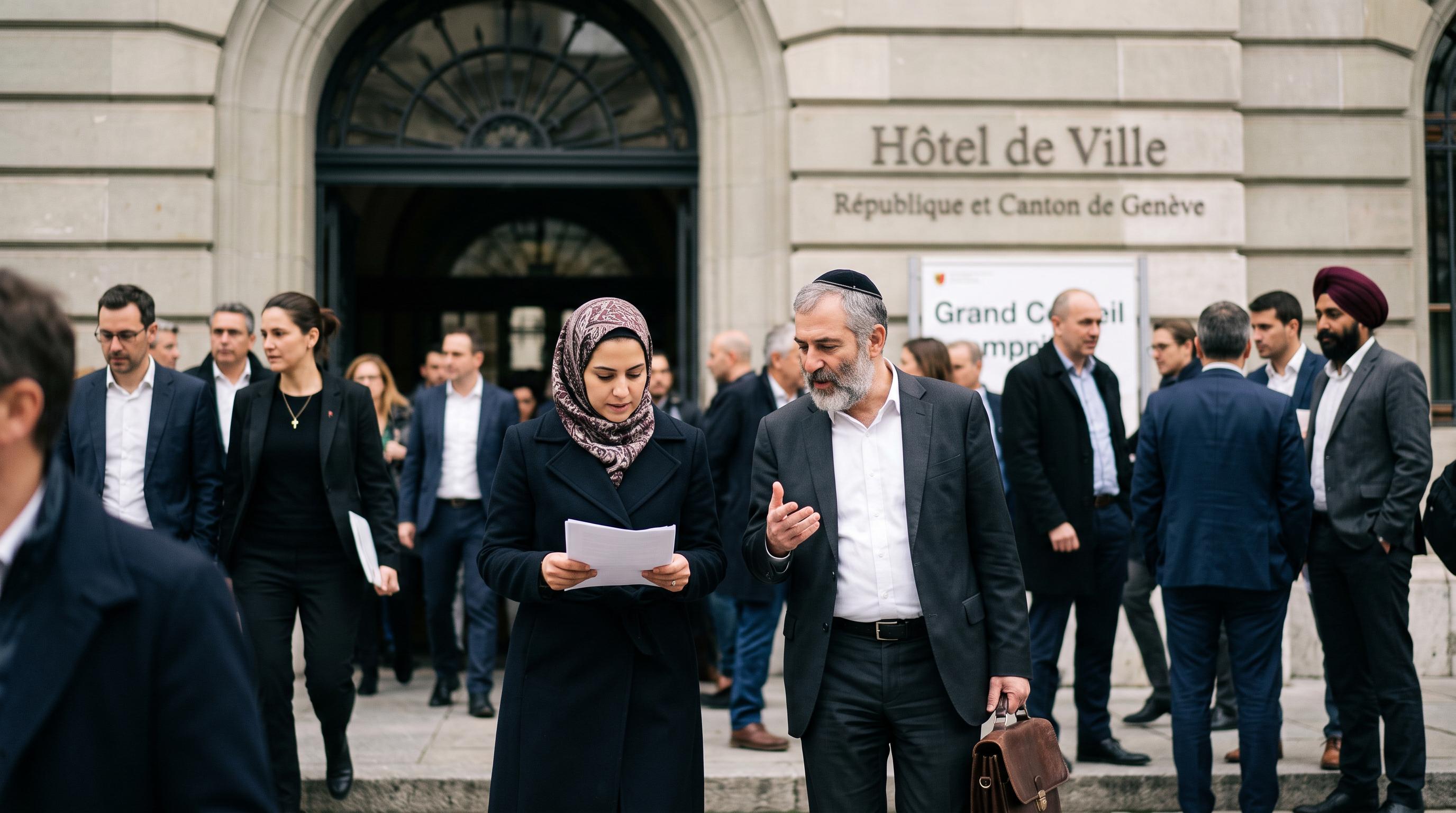
Geneva’s Ban Enters the Courts
Four legal challenges have pushed Geneva’s new religious-symbols ban from the ballot box into the courts. The constitutional amendment prevents members of cantonal and municipal parliaments from wearing conspicuous religious symbols while serving as elected legislators. The list includes headscarves, kippahs and crosses.
Voters approved the measure by 51.5% in June 2026, a margin that left the political dispute unresolved. The proposal had been backed by the Swiss People’s Party, the Liberals, the Centre and Geneva’s Mouvement Citoyen Genevois. Geneva’s government opposed it. Carole-Anne Kast, a Socialist member of the cantonal executive, called the amendment unconstitutional after the result.
The court cases raise a question with consequences beyond Geneva’s chamber: how far can a canton extend public-sector neutrality into the work of elected representatives? The challengers include Green parliamentarians, evangelical Christians, a Protestant local politician and two private citizens, one Muslim and one Christian. They say the ban infringes freedom of conscience, democratic principles and other fundamental rights.
The cases will test whether Geneva’s constitutional rules can withstand review under higher law and whether the canton’s distinctive model of secularism can apply equally to political representatives.
Lawmakers Test Geneva’s Neutrality Rule
The amendment targets elected lawmakers, a category Geneva previously kept outside its neutrality rules. Since 2019, members of the cantonal government and municipal executives have had to refrain from displaying religious symbols while carrying out official duties. Civil servants and teachers face similar restrictions.
Parliamentarians were excluded because Geneva’s Constitutional Chamber drew a legal distinction between the state and the legislature. Elected representatives, according to that reasoning, express the diversity of society rather than embodying the state in the same way as officials exercising executive authority.
Supporters of the new ban rejected that separation. They argue that the parliamentary chamber must also project confessional neutrality and that visible religious signs can affect how debates are perceived. Céline Zuber-Roy, an FDP parliamentarian, dramatized the point last year by appearing in the chamber wearing a colander. The object is associated with Pastafarianism, a satirical religion created by American physics graduate Bobby Henderson in 2005.
The stunt was designed to test the boundary between personal expression and institutional appearance. Parliament later voted to place the restriction in the cantonal constitution, sending the issue to voters. The legal challenge now asks whether that choice crossed limits set by fundamental rights.
Challengers Put Fundamental Rights on Trial
The challengers say a popular vote cannot override protected rights. Four complaints have been lodged, according to SRF. The first was filed in December 2025, while the latest arrived in September 2026 from two private citizens, one Muslim and one Christian.
Their arguments converge on the same legal concern: the constitutional amendment may restrict freedom of conscience and religion, democratic participation and individual rights. The involvement of people from different religious and political backgrounds gives the challenge a broader footing than a single dispute over one garment or symbol.
Green members of Geneva’s cantonal parliament, evangelical Christians and a Protestant local politician have also brought challenges. Their objections focus on the constitutional compatibility of a rule that applies to visible religious expression by elected representatives, even when those representatives do not exercise executive power.
The courts will have to assess the amendment within Switzerland’s federal legal framework. The source material does not identify the court’s timetable or predict an outcome. Any ruling could clarify how Geneva must reconcile its constitutional commitment to secular government with the rights of candidates and elected officials to maintain visible religious identities while participating in public life.
Geneva’s Secular Tradition Sets the Terms
Geneva has enforced a strict version of secularism since 1907. The canton’s separation of church and state has produced rules that reach further into public-sector conduct than those found in Switzerland’s other cantons. The current controversy follows that long institutional tradition, while widening its reach to elected legislatures.
The Geneva model is often compared with France’s concept of laïcité, which seeks to keep public institutions religiously neutral. In Geneva, the principle already governs parts of the public sector. The 2019 restrictions on government members, municipal executives, civil servants and teachers established the framework that supporters later sought to extend to parliamentarians.
Critics of the expansion argue that neutrality can become a restriction on the people who participate in public institutions. A ban on visible symbols may prevent voters from seeing representatives who reflect the canton’s religious and cultural diversity. Supporters answer that parliament must appear institutionally neutral and that conspicuous symbols can distract from political debate.
The dispute therefore turns on the legal status of representation. If lawmakers speak for the electorate while remaining private individuals, the existing distinction may survive. If their presence in the chamber carries the state’s authority, Geneva’s broader neutrality rules may gain support.
The Ruling Could Redraw Swiss Neutrality
A court ruling could reshape the boundary between neutrality and representation across Geneva. If judges uphold the amendment, the canton will have constitutional authority to restrict conspicuous religious symbols among members of both cantonal and municipal parliaments. That would place elected legislators under the same broad neutrality project that already covers executives, civil servants and teachers.
If the court rejects the measure, Geneva may have to preserve the distinction between representatives who debate and legislate and officials who act directly on behalf of the state. The ruling could also require lawmakers to revisit the constitutional text or its implementation, depending on the court’s reasoning.
The case matters beyond the immediate dispute over headscarves, kippahs, crosses or the symbolic colander. It concerns who may visibly participate in democratic institutions and what a secular canton may demand from those representatives. The narrow referendum result adds political context, while the four legal challenges place the decisive next step in the judicial system.
Other Swiss cantons will be watching how Geneva’s courts balance a canton’s authority to define public neutrality against protections for religious freedom and democratic participation. The source material gives no date for a decision, leaving the amendment’s practical future uncertain.