crime
Fraud nearly doubles as crime rises in Switzerland
A new survey finds that fraud and other property offences have risen sharply in Switzerland since 2022. The share of respondents reporting fraud victimisation nearly doubled to 15. 9% in 2025, while confidence in personal safety declined.
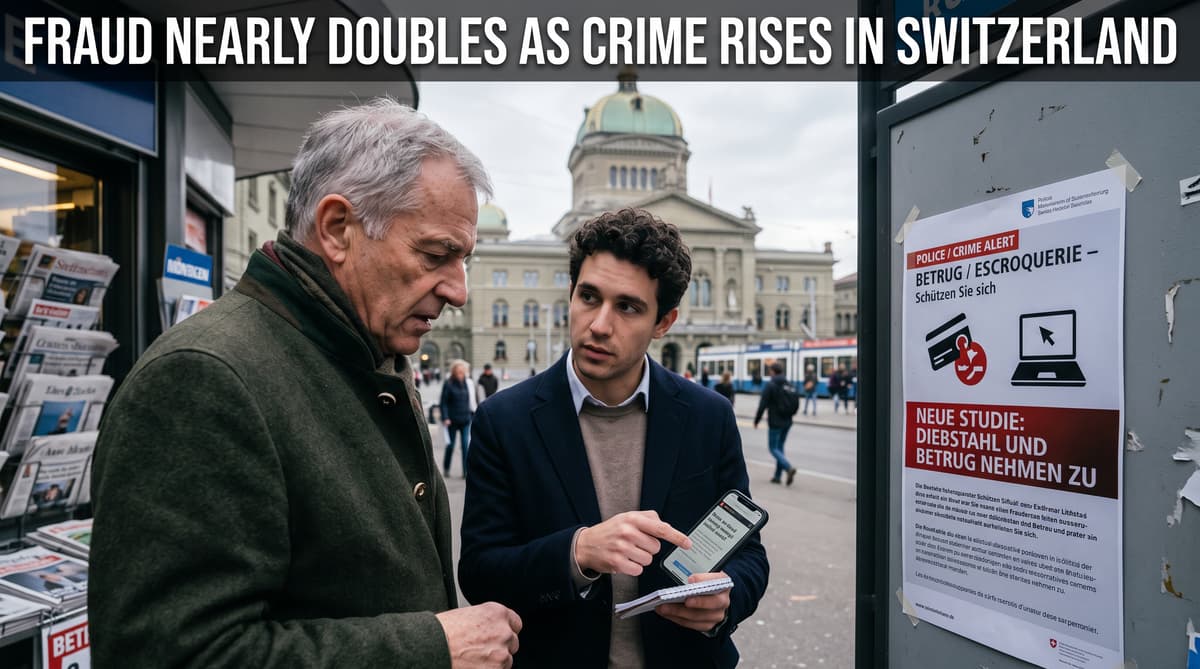
Fraud affected 15.9% of respondents in 2025, nearly twice the 8.4% recorded in 2022. The figure sits at the centre of a new national survey showing that more people in Switzerland experienced crime across the period, while confidence in personal safety weakened.
The Crime Survey 2025, published on October 15 by the Zurich University of Applied Sciences and the University of St Gallen, draws on responses from 13,500 people aged 16 to 80 living throughout the country. Participants reported more victimisation for almost every offence examined. Fraud recorded the sharpest rise, with about three quarters of cases taking place online, including through social media.
The findings add a victimisation measure to police statistics. They also capture offences that never reach the authorities. Reporting rates remained broadly stable compared with 2022, according to the researchers, suggesting that the increase cannot be explained mainly by a greater willingness to contact police.
The survey arrives alongside continuing public debate about crime trends in Switzerland. It points to a broad shift in exposure to property crime, rather than a single isolated change in behaviour. Sexual offences were an exception, with no increase in the reported victimisation rate, although sexual harassment rose.
Track the Digital Scam Wave
Online platforms account for roughly three quarters of the fraud cases reported in the survey. The finding places digital deception at the heart of Switzerland's changing crime profile. Social media was among the channels identified by the researchers, alongside the wider online environment where victims can be targeted across cantonal and national borders.
The survey does not provide a breakdown by scam type, canton or financial loss. It does show that fraud has become a much more common experience for respondents than it was three years earlier. Because the question covers the previous twelve months, the 2025 result reflects recent exposure rather than a lifetime record of victimisation.
Other property offences also moved higher. The share reporting theft of personal belongings rose from 3% to 4.3%, while theft from cars more than doubled in relative terms, from 1.2% to 2.7%. These figures are survey responses, not police case totals, and they include incidents that may not have been reported.
Dirk Baier, who jointly leads the project at ZHAW, said reporting behaviour had remained nearly unchanged. The implication is significant for analysts: official records alone may not capture the full reach of property crime, especially when victims decide that reporting will not recover lost money or prevent a repeat.
Rebuild Confidence After Dark
Only 83.1% of respondents felt fairly or very safe after dark in their neighbourhood in 2025, down from 87.6% in 2022. The change was accompanied by a stronger fear of becoming a victim of street crime during the previous twelve months.
Perceptions of police visibility shifted as well. The proportion describing police presence in public spaces as insufficient reached 37.9%, compared with 28.9% in 2022. The survey did not identify a specific town or canton driving that result. It measured how residents viewed safety in their own surroundings across Switzerland.
Trust in the police nevertheless remained high. That combination gives the findings a more precise meaning than a general collapse in confidence. Many respondents continue to view the police as legitimate and reliable, while asking for a more visible presence in public areas.
Nora Markwalder, co director of the project and a professor at the University of St Gallen, said researchers did not regard the decline in safety perceptions as dramatic. She urged decision makers to take the trend seriously without overstating it. Switzerland remains widely regarded as a safe country, even as more residents report crime and feel less secure after dark.
Read the Different Crime Patterns
Sexual harassment rose from 4.3% to 6.2%, while the survey found no increase in sexual violence. The distinction matters because the study recorded different trajectories across offences rather than a uniform rise in every category.
The researchers also examined domestic violence in a supplementary report. Over a five year period, the overall share of people reporting at least one form of domestic violence had not changed significantly compared with 2022. The gender gap remained pronounced: 5.4% of women and 2.2% of men said they had experienced domestic violence.
Dirk Baier said the higher rate among women appeared in both official statistics and unreported cases. He linked the findings to the need for continued prevention measures against violence targeting women. Among the individual forms of domestic violence examined, only domestic hate crimes showed a statistically significant increase compared with 2022.
The survey's value lies partly in these distinctions. It places online fraud, theft, harassment and domestic violence in the same national assessment while preserving their different patterns. The results show where reported exposure increased, where it remained stable and where perceptions changed faster than measured victimisation.
Turn Survey Evidence Into Prevention
The survey gives Swiss authorities a wider warning than police figures alone can provide. Its 2025 results combine reported victimisation, experiences that remain unreported and public perceptions of safety. That makes the next response relevant to police forces, cantonal prevention offices, schools, banks, online platforms and local governments.
The immediate challenge is fraud prevention. With 15.9% of respondents reporting fraud in a single year and most cases occurring online, public guidance must reach people where scams appear, including social media. Better awareness cannot replace enforcement, but it can help residents recognise deceptive requests before money or personal data changes hands.
Public space also matters. More respondents said police presence was insufficient, even though trust in the police remained high. Authorities will need to assess where visibility, victim support and communication can make the greatest difference. The survey does not prescribe a single national solution, and it offers no canton by canton ranking.
For researchers, the next comparison will show whether the 2025 movement persists. For residents, the findings offer a clear picture of the present: Switzerland remains broadly safe, yet fraud, property crime and concerns about safety have moved higher since 2022.