Justice
Court Orders Bern to Re-Examine Repatriation Request for Swiss IS Fighter
The Federal Administrative Court has overturned a foreign ministry decision, ruling that the repatriation request of a Swiss man believed to be an Islamic State fighter detained in Iraq must be reconsidered. The case carries significant weight as the individual faces a potential death penalty.
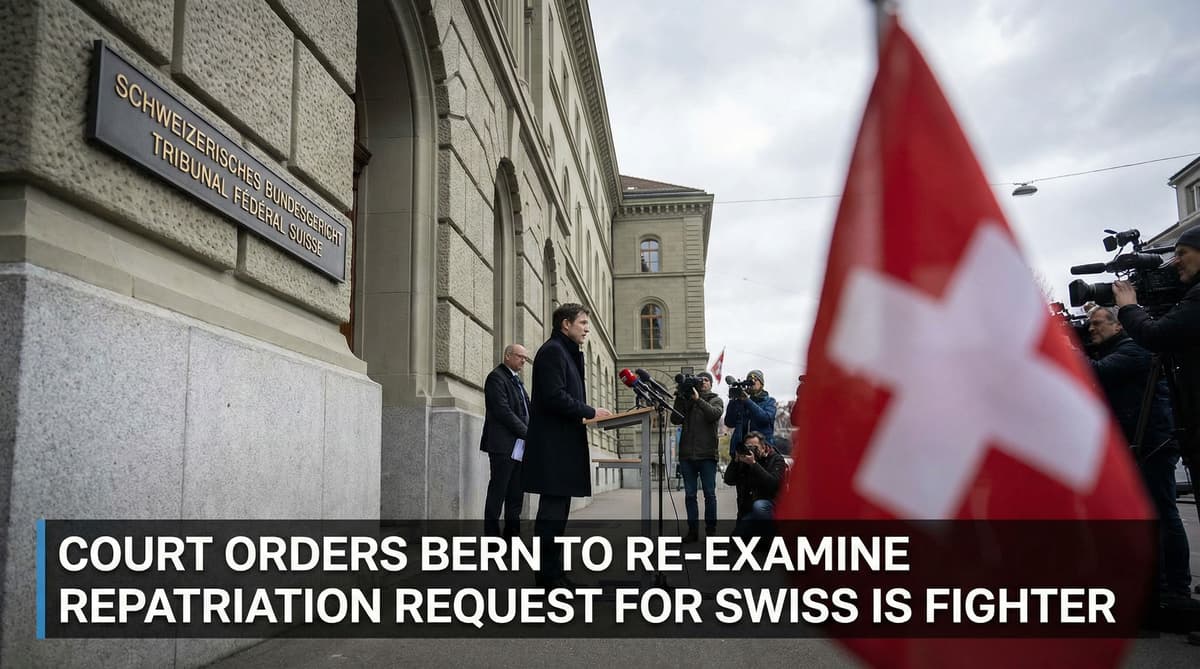
Switzerland’s highest administrative authority has delivered a stinging rebuke to the foreign ministry, shattering the government's wall of silence regarding the fate of Swiss jihadists abroad. The Federal Administrative Court has officially overturned a September 2025 decision that blocked the repatriation of a Swiss national believed to be an Islamic State fighter. This isn't just a procedural hiccup; it is a fundamental challenge to how Bern balances its distaste for terrorism against its constitutional obligation to protect the lives of its citizens. The man at the center of this storm, a French-speaking national who joined the caliphate in 2015, now stands at the threshold of a legal precedent that could force Switzerland to bring its most controversial citizens home. While the government has long maintained a policy of non-intervention for those who voluntarily joined terrorist ranks, the court has signaled that the threat of the death penalty overrides political negligence.
From Syrian Sands to Iraqi Nooses
The geography of terror has shifted, and with it, the legal urgency for Swiss diplomats. Since January, American forces have executed a massive logistical operation, transferring suspected IS members from Kurdish-led SDF camps in Syria to the notorious Al-Karkh Central Prison in Baghdad. Among those caught in this high-stakes shuffle are at least 3 Swiss nationals. This transition is a death sentence in waiting. Unlike the legal limbo of northern Syria, Iraq’s anti-terrorism laws are swift and lethal, frequently resulting in the death penalty for anyone found to have supported the Islamic State. The court noted that these individuals are to be tried in a jurisdiction where execution is a standard outcome. This dramatic escalation in risk has effectively stripped the Swiss foreign ministry of its ability to look the other way. The 'negligent' actions of a citizen in 2015 no longer justify the state's silence when the gallows are being prepared in 2026.
The High Stakes of Consular Duty
Consular protection is not a luxury; it is a lifeline that the state cannot arbitrarily sever when lives are on the line. The Federal Administrative Court’s ruling clarifies a critical boundary: while Switzerland can restrict assistance to protect its foreign policy interests, it cannot do so when a citizen’s physical integrity is at risk. The foreign ministry's 2025 rejection was based on the premise that the fighter had forfeited his right to help by joining a terrorist group. However, the court has now ruled that the absolute right to life takes precedence over the 'negligence' of joining a conflict. This creates a staggering dilemma for Bern. If the government is forced to facilitate the return of one fighter to prevent an execution, it opens the floodgates for others. The ruling demands a re-examination that must account for the brutal reality of the Iraqi justice system, where the line between 'support' and 'active combat' is often blurred by the shadow of the hangman.