Gerold Späth
Swiss author Gerold Späth dies aged 86
Swiss author Gerold Späth has died at the age of 86, two days before his 87th birthday. Known for his linguistically rich and sharply critical novels, Späth was one of the most distinctive Swiss-German literary voices of the 1970s and 1980s.
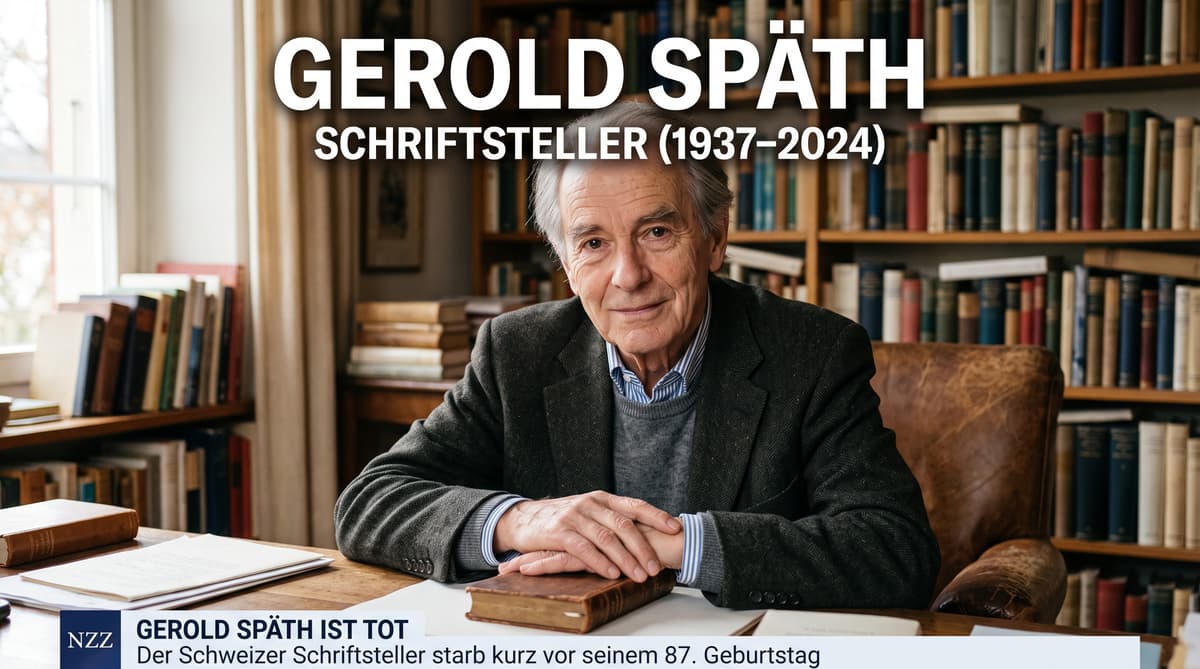
Gerold Späth died on October 14, 2026, aged 86, closing the life of a writer who gave Swiss-German literature one of its most unruly and recognisable voices. His family informed Lenos Verlag of his death one day before the publisher issued its tribute. Späth would have turned 87 two days later.
Lenos Verlag described him as a “great storyteller”. The assessment reflects the scale of his literary presence during the 1970s and 1980s, when his novels stood out for their linguistic density, grotesque humour and sharp criticism of Swiss social life. His writing examined the narrow-mindedness, self-righteousness and double standards that could hide behind the country’s idyllic image.
Späth’s work carried the marks of a singular imagination. The publisher characterised it through “baroque opulence, a delight in language, crude humour and abysmal melancholy”, a combination that made him difficult to place within a single literary tradition. His death removes a major figure from the generation that reshaped modern Swiss-German prose.
Trace the debut that set the tone
Späth published Unschlecht in 1970, making an immediate mark with a debut that Lenos Verlag still identifies as a literary masterpiece. The novel established the qualities that would define his reputation: exuberant language, a taste for the grotesque and an unsparing view of social behaviour.
That combination placed Späth firmly within the literary debates of his era. His books challenged the polished image of Switzerland by exposing provincial habits and moral posturing. He wrote from inside the country’s language and culture, while turning their conventions into material for satire. The result was a body of work that could be comic, abrasive and sombre within the same imaginative frame.
Critics and readers compared Späth with several major European predecessors. He was called a new Rabelais, a modern Grimmelshausen and a Swiss Boccaccio. The comparisons pointed to his appetite for excess, his interest in human folly and his command of comic invention. They also underlined the unusual scale of his ambition in Swiss-German prose.
His first novel arrived 56 years before his death, yet its influence remains central to accounts of his career.
Read the Swiss world he questioned
Rapperswil shaped the landscape behind Späth’s writing. Born in 1939 on the upper Lake Zurich, he grew up in a dynasty of organ builders. The setting connected him to a specific Swiss tradition of craft, music and close-knit local life, even as his fiction attacked the complacency that such communities could foster.
Späth’s literary Switzerland was rarely a postcard. He targeted narrow-mindedness, self-righteousness and double standards in the supposedly idyllic world around him. His method was linguistic as much as thematic. He pushed words towards comic excess, used crude humour to unsettle respectable appearances and allowed melancholy to sit beside the laughter.
That mixture gave his work a distinctive cultural position. Späth wrote in the German-speaking Swiss sphere, yet his concerns reached beyond regional colour. The tension between public respectability and private weakness, between community belonging and individual defiance, supplied the energy for his fiction.
His origins in Rapperswil did not confine him to local literature. They gave him the social and cultural materials that he transformed into a broader critique of Swiss life. The organ-building family background also offered a telling contrast with his prose, which was less interested in harmony than in exposing discord.