space
Swiss analysis of Bennu dust revises asteroid’s origin story
Research using a small sample returned by NASA’s OSIRIS-REx mission suggests asteroid Bennu formed near the early solar system’s water-ice boundary rather than in its distant outer regions. The ETH Zurich analysis offers a fresh view of how planetary bodies formed 4. 5 billion years ago.
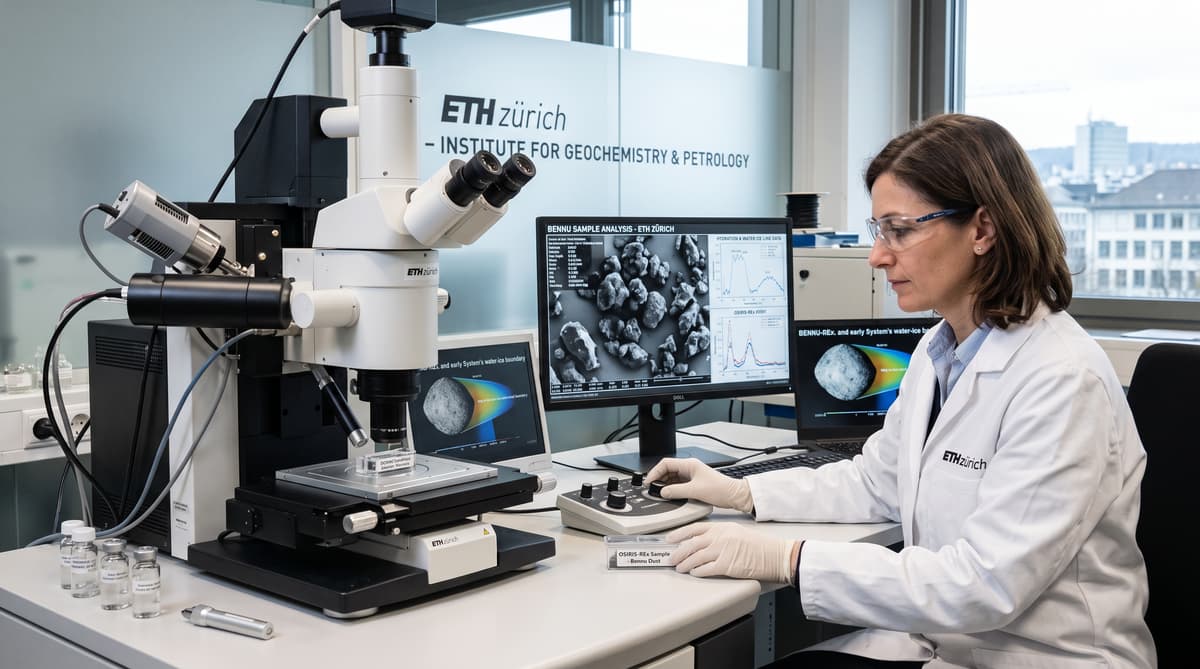
Half a gram of asteroid dust is forcing scientists to redraw Bennu's family history. Researchers at ETH Zurich have analysed a portion of the material NASA brought back from Bennu and found chemical evidence that points to a formation site near the early solar system's water ice boundary. The result challenges the long-held view that Bennu formed late and far from the Sun, in the cold outer region associated with comet origins.
NASA's OSIRIS-REx spacecraft delivered 120 grams of Bennu rock and dust to Earth in 2023. ETH Professor Maria Schönbächler's laboratory received 0.5 grams, a small fraction that has yielded information about the conditions prevailing as the planets began to take shape.
The findings, reported in Science Advances, focus on the isotope and chemical signatures of iron, titanium and chromium. Those elements preserve clues about the environment in which Bennu's material assembled. The research gives Swiss planetary science a direct role in interpreting one of the most important extraterrestrial sample returns in decades, while adding a new chapter to the history of a small asteroid that may preserve material from the solar system's earliest era.
Chemical Clues Place Bennu Near the Ice Line
Bennu likely formed around 4.5 billion years ago in a transition zone, close to the water ice boundary. This boundary marked a major change in the young solar disc. Beyond it, temperatures were low enough for water to freeze and become part of the solid material available to growing planetary bodies. The location influenced which minerals and compounds could survive and combine.
Earlier models placed Bennu's birthplace much farther out, near the icy edge of the solar system. That interpretation fitted the asteroid's abundance of water and organic material. ETH Zurich's analysis points to a more complicated history. The chemical signals carried by iron, titanium and chromium indicate that the material making up Bennu may have assembled in a region where dust from different parts of the young disc came together.
The result does not describe Bennu as a simple, untouched fragment from one location. It suggests that the asteroid contains a record of movement and mixing during the solar system's formative period. Scientists can use that record to test models of how dust became larger bodies, how water entered planetary building materials and how the early disc distributed elements across space.
Jupiter May Have Mixed Bennu's Building Blocks
Jupiter may have acted as a gatekeeper in the young solar system. ETH researchers propose that the gas giant formed very early and blocked larger, coarse material from crossing freely through the solar disc. Fine dust, however, could continue to flow from different regions and gather in a transition zone around Jupiter's orbit.
That process offers a route for Bennu's ingredients to mix. Dust with different chemical histories may have combined before later accumulating into larger bodies, including the precursors of Bennu. The explanation places Jupiter in a wider planetary role than that of a distant giant planet. Its early growth may have helped organise the distribution of material from which the inner and outer solar system developed.
The hypothesis also helps explain why a water rich, organic material bearing asteroid could carry chemical signatures associated with a different formation environment than scientists previously assumed. Bennu's composition records the movements of dust as much as the conditions at a single birthplace. Further study of the remaining OSIRIS-REx material will be needed to test how widely this mixing model applies across Bennu's samples and other primitive bodies.
Bennu Offers Clues to Earth's Raw Materials
Bennu's water and organic material connect a Swiss laboratory's measurements to the earliest ingredients of Earth. The asteroid is rich in both, making its returned samples valuable to researchers studying how young planets acquired volatile compounds and carbon based material. ETH Zurich's work does not establish that Bennu delivered life to Earth. It helps identify the environments in which some of the relevant building blocks formed and travelled.
For planetary scientists, the significance lies in the sample's physical record. Telescopes can measure an asteroid from afar, but laboratory instruments can examine its chemistry at far greater precision. The 0.5 gram sample studied in Zurich carries evidence that can be compared with meteorites, other asteroids and models of the solar disc.
The findings also underline the value of international space missions to Swiss research. NASA collected and returned the material, while ETH scientists helped interpret what it reveals about planetary origins. As researchers examine more of the 120 grams returned in 2023, they may refine the picture of Bennu's formation, the role of Jupiter and the pathways that moved water and organic compounds through the young solar system.