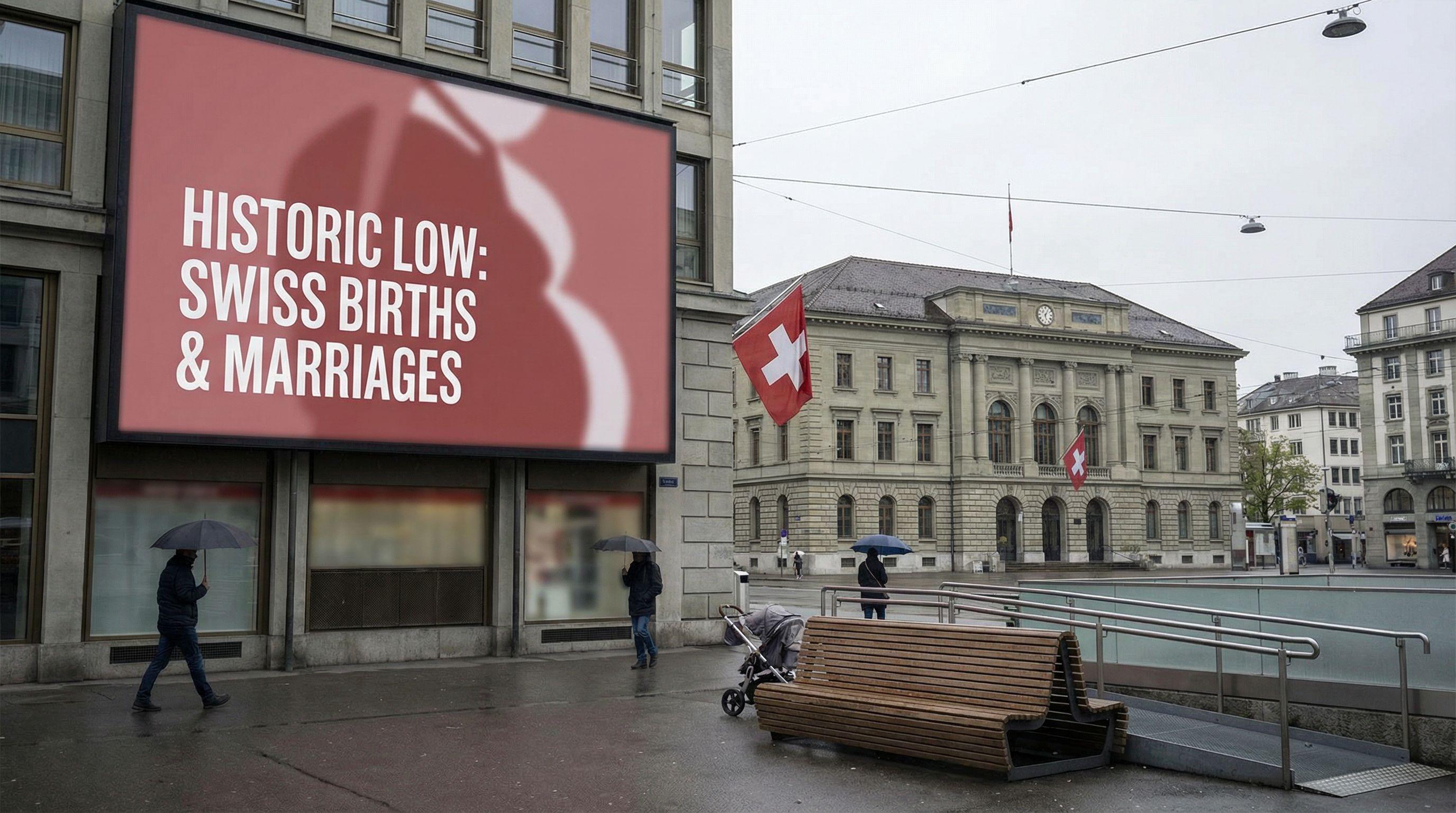
Swiss Marriage and Birth Rates Hit Historic Low
New federal statistics reveal continuing decline in Swiss marriage and birth rates, with 2024 fertility rate dropping to 1.29 children per woman, raising concerns about demographic challenges.

"Marriage is now just one relationship model among many. But the more pressing concern is the plummeting birth rate. Today, children are seen as a burden."
Switzerland has reached a critical demographic milestone as fertility rates plunge to unprecedented levels. According to the latest data from the Federal Statistical Office (FSO), the fertility rate has dropped to 1.29 children per woman in 2024, marking the lowest point since modern record-keeping began. This represents a significant decline from 1.5 children per woman just a decade ago.
The impact is clearly visible in the annual birth statistics, with only 78,300 children born in 2024 â 1,800 fewer than the previous year. This marks the third consecutive year of decline in birth rates. The trend is particularly noteworthy when compared to historical figures: in 1879, Swiss women had an average of four children, while in 1963, the average still stood at 2.7 children per woman.
A significant factor in this demographic shift is the increasing age of first-time mothers, now averaging 31.3 years. The data reveals a particularly sharp decline in second and third births, with drops of 2.8% and 3.6% respectively, while first births showed a more modest decrease of 1.5%.
The institution of marriage in Switzerland is experiencing a parallel decline, with only 36,800 couples exchanging vows in 2024 â the lowest number since 1981, excluding pandemic years. This represents a 2.6% decrease from the previous year, highlighting a significant shift in social attitudes toward traditional family structures.
Divorce rates have simultaneously increased by 3.6%, with marriages lasting an average of 15.8 years before dissolution. While the long-term divorce rate has stabilized over the past 15 years, the declining number of marriages suggests a fundamental change in how Swiss society views formal relationships.
Sociologist Katja Rost from the University of Zurich offers insight into this transformation, noting that 'Marriage is now just one relationship model among many.' This shift reflects broader changes in Swiss society, where traditional family structures are increasingly giving way to alternative living arrangements.
The demographic transformation is not uniform across Switzerland, with notable regional variations in both marriage and birth rates. While the national trend shows decline, some cantons present interesting exceptions. The cantons of Glarus, St. Gallen, and Aargau have shown resistance to the declining marriage rate trend, though population growth in St. Gallen and Aargau may partially explain this phenomenon.
Urban areas are experiencing particularly pronounced changes. Zurich, Switzerland's largest city, has witnessed a dramatic 14% decrease in births over the past decade. Rural areas are not immune to these changes either, with mountain communities in GraubĂźnden showing significant declines in birth rates.
These regional variations reflect different socio-economic conditions and cultural attitudes across the country, while still conforming to the broader national trend of declining fertility and marriage rates.
The continuing decline in both marriage and birth rates poses significant challenges for Swiss society. With just 6,300 net natural population increase â the smallest in over a century â Switzerland faces potential demographic challenges as its population ages.
Practical obstacles to family formation are mounting. The scarcity and high cost of housing, coupled with the increasing necessity of dual-income households, create significant barriers for potential parents. Limited access to childcare and its associated costs further complicate the decision to have children.
As noted by sociologist Katja Rost, children are increasingly viewed as a burden in contemporary Swiss society. This perception, combined with practical challenges, suggests that reversing the current demographic trend will require both cultural shifts and policy interventions.
The implications of these trends extend beyond family structures to impact various aspects of Swiss society, from pension systems to economic growth. As Switzerland continues to navigate these demographic changes, the need for adaptive policies and social support systems becomes increasingly apparent.