Switzerland-China relations
Switzerland and China sign updated trade deal to remove tariffs on exports
Switzerland and China have signed an updated free trade agreement that would abolish tariffs on almost all Swiss exports to China if ratified by the Swiss parliament. The deal also includes binding provisions on sustainable trade, alongside agreements on employment cooperation and research.
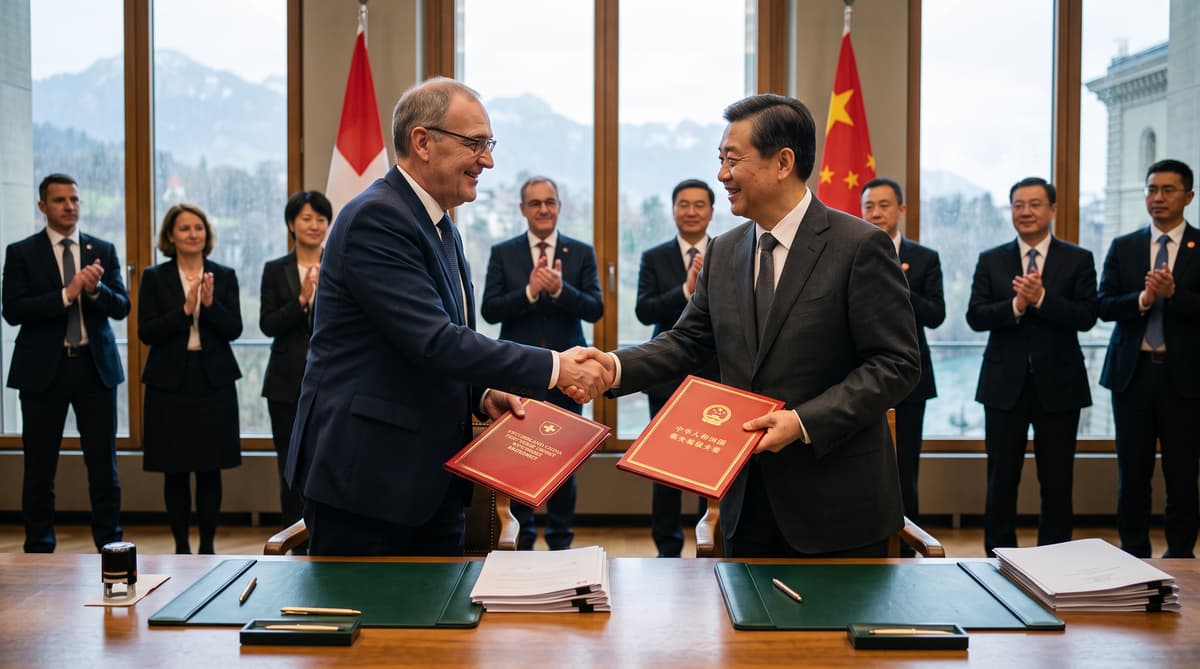
Nearly all Swiss goods exports could enter China without tariffs under the revised deal. President Guy Parmelin and Chinese President Xi Jinping signed the agreement in Beijing on Friday, October 30, at the Great Hall of the People. Swiss parliamentary ratification is needed before the tariff changes take effect.
The updated pact would extend duty-free access to 99.8% of Swiss exports over 10 years, up from around half of Swiss shipments previously. The two governments first announced the deal in August, following negotiations to modernise an agreement that has been in force since 2014.
The signing comes as China has raised trade barriers against many European countries and the United States. Switzerland is the only country in continental Europe with a free trade agreement with China, making the revised terms closely watched beyond Swiss business. The pact also addresses services, employment cooperation and research, placing a broader set of economic ties alongside the tariff changes.
Open the Door for Swiss Exports
Swiss watches, cheese and coffee are among the products set to gain from tariff removal. Duties would be eliminated on all Swiss watch imports to China, compared with just 1% that were previously tariff-free. Watchmakers would still face China’s luxury consumption tax.
The tariff cuts would also bring Swiss cheese and coffee into line with exports such as chocolate and wine, which already entered China duty-free. The revised agreement reaches beyond goods: it grants Switzerland greater access in manufacturing-related services, aircraft maintenance and maritime transport.
The expansion works in both directions. Switzerland would remove tariffs on 97.3% of Chinese agricultural exports, up from 80.1% under the existing terms. The revised coverage signals a wider opening of both markets, though the largest change for Swiss exporters is the increase in duty-free access for Swiss goods. The agreement sets out a phased path, with the 99.8% target for Swiss exports due over 10 years.
Bind Trade to Sustainability Rules
The agreement adds binding environmental and labour provisions, a first for a Chinese free trade agreement, according to Switzerland. Its legally binding chapter on trade and sustainable development strengthens rules on environmental protection and labour standards within the commercial pact.
The governments also signed a separate agreement on cooperation in labour and employment. A further agreement provides for regulated cooperation in research and development. Parmelin described the deal as “a new step” that also encompasses research, innovation, science and labour-related issues.
These provisions broaden the agreement beyond market access. Switzerland and China already had a free trade pact in force from 2014; the revised text updates that framework while bringing sustainability and cooperation into the same package of agreements. For Swiss companies looking at the Chinese market, the commercial changes sit alongside new commitments on standards and collaborative work. The sustainability chapter is legally binding, according to the Swiss account of the deal.
Weigh Trade Gains Against Strategic Risks
Switzerland and China traded around CHF 33.5 billion in goods in 2025, excluding gold and other valuables. Swiss exports accounted for CHF 15.2 billion, while imports from China reached around CHF 18.3 billion, according to the Swiss economic ministry. The revised agreement would change the terms governing a substantial commercial relationship.
The deal arrives amid heightened trade barriers between China and several major economies. Switzerland also faces a strategic balancing act: it is outside the European Union but participates in the bloc’s single market through bilateral agreements, while maintaining its own free trade pact with Beijing. Observers are watching how Bern weighs economic openness against security and technological concerns.
Selina Hanni, a Swiss public affairs specialist at the World Economic Forum, wrote that Switzerland’s approach “could set an example for other economies.” The immediate next step is parliamentary ratification in Switzerland. If approved, the agreement would begin the process of extending tariff-free access to almost all Swiss exports to China over the coming decade.