Alain Berset
Berset defends young people’s right to protest as Swiss mobilisations loom
Council of Europe Secretary General Alain Berset has defended young people’s right to demonstrate while condemning violence at protests. A day of mobilisation is planned in several Swiss cities on November 20 amid wider youth demonstrations across Europe.
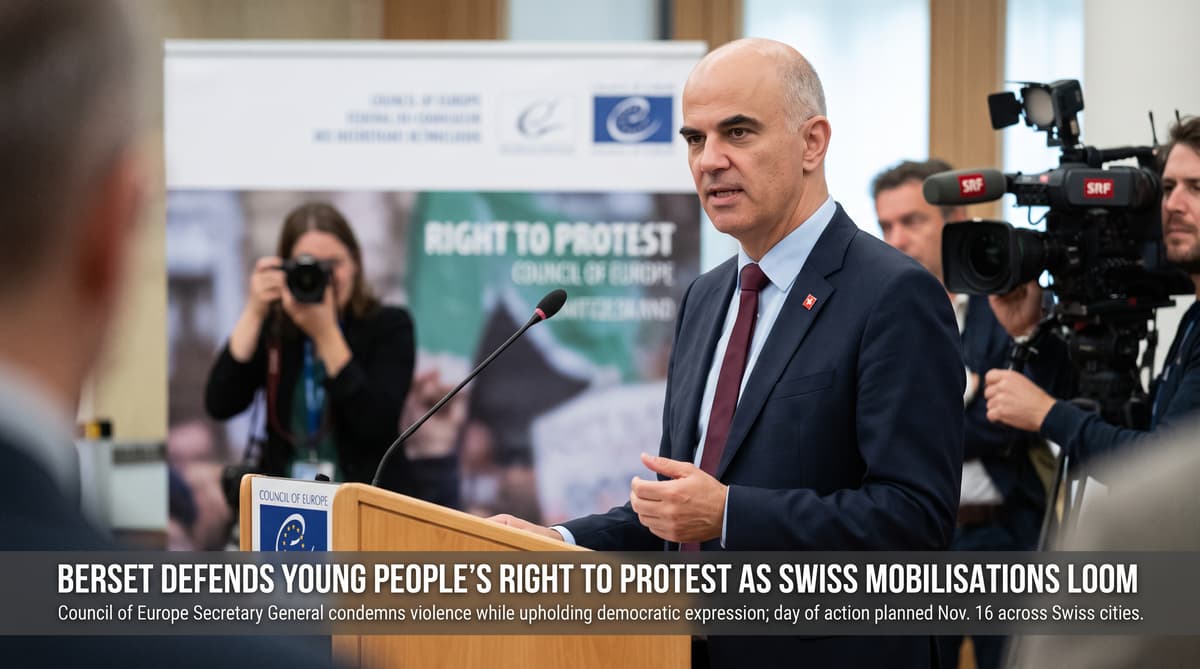
Youth demonstrations are spreading across Europe, with Swiss mobilisation planned for November 20. Young people have taken to the streets in France, Albania, Italy, Spain and Portugal over recent weeks, raising concerns that range from unaffordable housing and the cost of living to pressure on schools and public services. Mistrust of political leaders is also part of the picture.
The planned day of action in several Swiss cities brings that wider discontent closer to home. Alain Berset, the Council of Europe’s Secretary General and a former Swiss minister, addressed the protests on Wednesday in an interview on RTS Forum, during the Swiss Parliament’s Foreign Policy Day.
Berset described the demonstrations as a sign of “living democracy”, while drawing a clear line at violence. His intervention comes as European governments face pressure over how to respond to unrest without weakening the right to peaceful assembly. For Switzerland, the November mobilisation will put those principles into a local setting.
Defend the right to protest
Berset defended peaceful protest as a democratic right and condemned violence in unequivocal terms. “You have the right to express your opinions, to meet peacefully, to have demands,” he said on RTS Forum, describing the ability to debate differences as part of a “living democracy”.
He warned that violence can damage the cause of protesters who have legitimate grievances. When demonstrations become violent, or groups use them to break or steal, Berset said, the conduct is “absolutely unacceptable”. It also risks calling the young demonstrators’ motivations into question, he argued.
That distinction matters as protests across Europe address pressures that touch everyday life, including housing, public services and precariousness. Berset’s position supports the right to assemble and make demands while rejecting destruction and theft. He said violent groups can instrumentalise movements, shifting attention away from the issues that brought young people into the streets. The challenge for public authorities, in his account, is to uphold public order without treating peaceful protest itself as a threat.
Trace the roots of youth anger
Berset sees a shared loss of confidence beneath protests rooted in different national grievances. The reasons young people take to the streets in France, he said, differ from those in Albania or Serbia. Yet he identified a common concern: the absence of convincing prospects in a world shaped by crises, wars and uncertainty about what comes next.
He contrasted that outlook with the sense of opportunity young people had 20 to 25 years ago, when many could imagine projects and room to develop. Today, Berset said, the continent faces war in Ukraine, the climate crisis, the recent pandemic and anxiety about artificial intelligence. He also cited the war in Iran and violations of international law.
Berset argued that the accumulation of threats erodes confidence in democratic systems. His comments connect economic and social pressures with a wider question of whether young people can picture a stable future. That concern crosses borders even when the immediate demands in each country differ.
Keep security from shrinking freedoms
Berset warned that governments must not trade away civil liberties in the name of security. In France, calls to limit demonstrations have followed looting and destruction. Berset cautioned against allowing violence to become a justification for reducing the right to express opinions, asking what freedom might be targeted next if that principle were accepted.
He said the Council of Europe had recently urged states concerned by demonstrations to respect the right to protest. Serbia offered a different example: after two years of demonstrations following the deadly collapse of a train station in Novi Sad, students won elections the previous Sunday. Berset said they had managed to channel protest into the democratic process, while noting that their work in government was still to come.
For Switzerland, the planned November 20 mobilisation will test the same balance Berset described: protect peaceful assembly, reject violence and keep political debate open. He ended with a call for a calmer, less crisis-driven world, saying, “We could use a little more boredom.”